Throughout the Bible, there is a seeming paradox: God is holy and just, but He is also loving and forgiving. God declares these things to be true about Himself in Exodus 34. He tells Moses that He is a “merciful and gracious God, slow to anger, abounding in steadfast love” (Exodus 34:6). But He also says that He will by no means clear the guilty (Exodus 34:7). We are left with the question: how can God be gracious, loving, and merciful, while also being a just, holy, fair judge of the guilty?
Continue reading “A Merciful God Who Doesn’t Clear the Guilty”Tag: Jesus
Why Manna? God’s Grace Displayed in Our Grumbling
In Exodus 16, the word “grumbling” is used eight times to describe Israel’s response to their hunger. It is easy to accuse them of lacking gratitude and faith, but I am afraid I would’ve been among their number. They watched God rescue them from slavery in Egypt with signs and wonders, yet they find themselves in the wilderness without food.
What was their response? They grumbled. They complained. They reminisced on how good the food was in their Egyptian slavery. They questioned all that God had done for them and wondered whether it was Him who did it after all. They blamed Moses, “you have brought us out into the wilderness to kill this whole assembly with hunger” (Ex 16:3).
Israel’s grumbling is not the response we expect when we read the story, especially right after God’s miraculous provision of water. But perhaps we should expect it. If we are honest, we probably would have grumbled too. But that’s good news. Because God’s responds in grace and provides for their needs.
In v. 4-8, God promised to send meat (quail) in the evening followed by bread in the morning. This bread was called “manna.” When Moses reveals this promise to the people, He begins by telling them that God “has heard your grumbling.” God responds to the people’s need without them asking. There isn’t a prayer uttered in this chapter. Just grumbling. Complaining. Blaming others. Yet God knew what His people needed. And He gave it to them. They were undeserving, yet He gave it to them. Why? Because He loves them. That’s grace!
Continue reading “Why Manna? God’s Grace Displayed in Our Grumbling”Matthew 5:1 & Jesus as the Greater Moses
As we begin considering the content of the Sermon on the Mount, we’ll quickly notice that every verse is packed with meaning, including the very first one. Matthew 5:1 reads, “Seeing the crowds, he [Jesus]went up on the mountain, and when he sat down, his disciples came to him.” In this verse, Matthew begins to reveal Jesus as the greater Moses. How? By the little phrase, “he went up on the mountain.”[1]
In Exodus 19:3, Moses “went up on the mountain” to receive God’s law and deliver it to the people of Israel. In the Greek Old Testament (The Septuagint), which Matthew was undoubtedly familiar with, the phrase describing Moses’ ascent reads, “ἀνέβη εἰς τὸ ὄρος.” Even if you can’t read Greek, you can see the identical nature of Matthew 5:1, which reads, “ἀνέβη εἰς τὸ ὄρος.” This phrase is used only three times in the Septuagint, each referring to Moses’ ascent to Sinai (Ex 19:3, 24:18, 34:4). This limited use makes the argument for Matthew’s intentional quotation compelling. He clearly wants his readers to note the connection and realize that Jesus was ascending the mountain to teach God’s people just like Moses did.
Continue reading “Matthew 5:1 & Jesus as the Greater Moses”Four Reasons the Sermon on the Mount is Relevant Today
In January, I started studying and writing on the Sermon on the Mount. A family wide bout of Covid-19 delayed my study for a little bit. But alas, God has allowed me to return to it! This week I want to share something I read from Martyn Lloyd-Jones on the Sermon. I am summarizing his comments under the title, “Four Reasons the Sermon on the Mount is Relevant Today.” Here they are:
1. Jesus died to enable us to live the Sermon on the Mount.
As I argued in my previous blog, the Sermon on the Mount is a description of the Christian life. Thus, Jesus died for us to be able to live out the principles of the Sermon. He died to “purify for himself a people for his own possession who are zealous for good works” (Titus 2:14). The principles contained in the Sermon are a part of these “good works.” In fact, God has planned from eternity past for us to walk in them (Eph 2:10). Because of Jesus’ death and the new life it has brought us, we can be zealous for doing the good works He expounds in the Sermon
Continue reading “Four Reasons the Sermon on the Mount is Relevant Today”God Walks on Water, Jesus Walks on Water
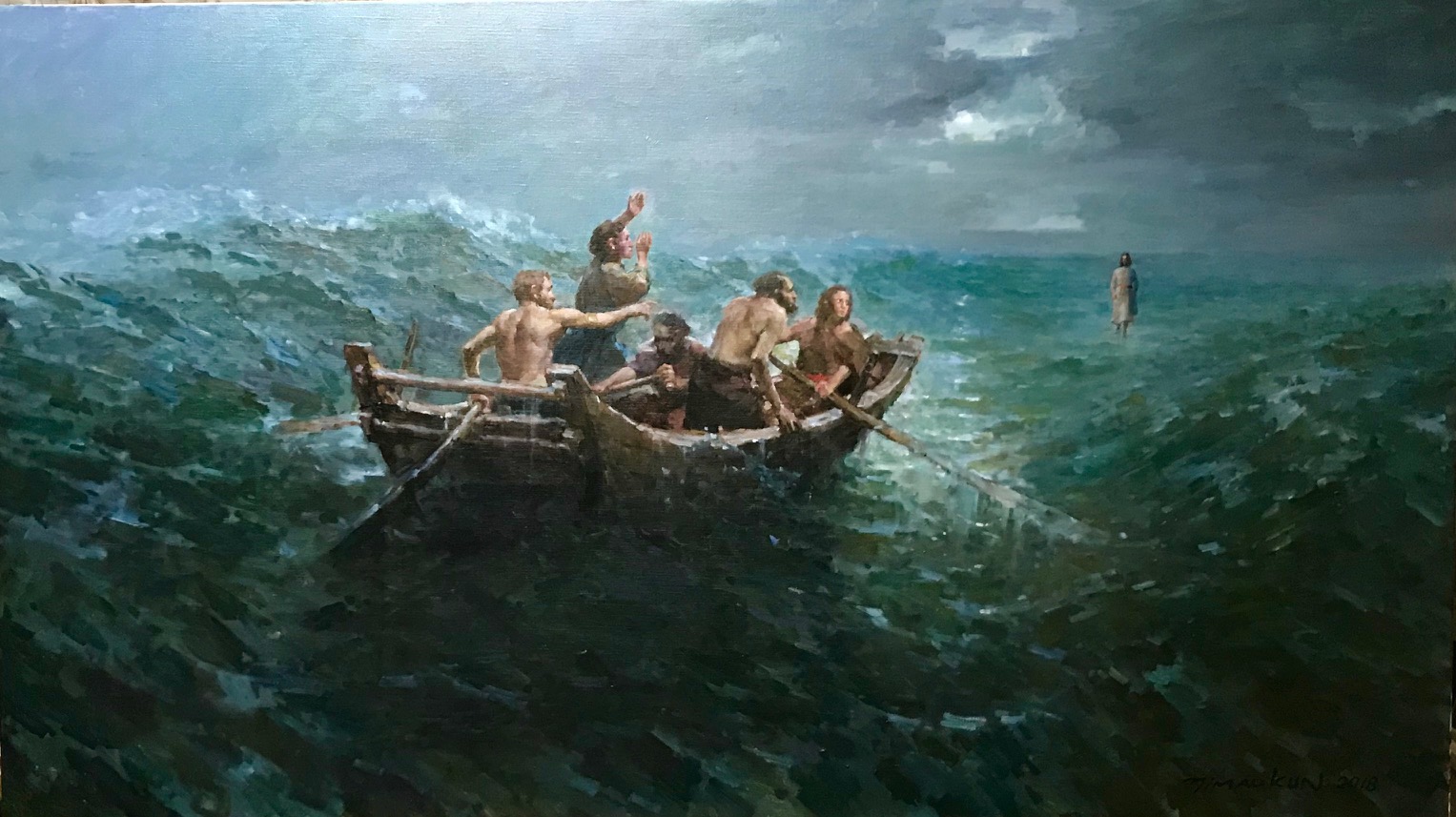
Jesus walked on water. Most people are familiar with this story. It may even be one of Jesus’ most remembered miracles, aside from rising from the dead or turning water into wine. But too often I read over it quickly and take it for granted. But this week I noticed a connection I haven’t seen before and I was able to see the profound message of the miracle in a new light.
Continue reading “God Walks on Water, Jesus Walks on Water”How did Jesus Come “By Blood and By Water?” An Exegetical Summary of 1 John 5:6
1 John 5:6- Text
Οὗτός ἐστιν ὁ ἐλθὼν δι’ ὕδατος καὶ αἵματος, Ἰησοῦς Χριστός· οὐκ ἐν τῷ ὕδατι μόνον ἀλλ’ ἐν τῷ ὕδατι καὶ ⸀ἐν τῷ αἵματι· καὶ τὸ πνεῦμά ἐστιν τὸ μαρτυροῦν, ὅτι τὸ πνεῦμά ἐστιν ἡ ἀλήθεια
Translation
“This is the one who came by water and blood, that is, Jesus Christ. (He came) not by the water only but by the water and by the blood. And the Spirit is the one who bears witness, because the Spirit is the truth.”
The Views
What does it mean that Jesus came “by water and blood?” There are at least six views: The first view understands the “water and blood” to refer to the rites of baptism (water) and the Lord’s Supper (blood). The second view understands the “water and blood” to refer to the “blood and water” that poured out of Jesus’ side on the cross (John 19:34-35). The third view takes the “water and blood” as referents to Jesus’ baptism (water) and his atoning death on the cross (blood).[1] The fourth view understands “by water” to refer to Jesus’ baptism ministry and “by blood” to his death. The fifth view takes “by water and blood” as a reference to natural birth, viewing the phrase as an argument for his real humanity. The sixth view takes “water and blood” as a unit reflecting the Jewish understanding of the body as composed of water and blood, making a statement analogous to John’s description of Jesus coming ‘in the flesh’ in 4:2.
Continue reading “How did Jesus Come “By Blood and By Water?” An Exegetical Summary of 1 John 5:6″
Why Did Jesus Say “I Thirst” On the Cross? A Sermon on John 19:28-29
I had the privilege of preaching the Good Friday sermon at our home church in Raleigh this year. When I was asked to preach, I was told that I would be continuing a series of the last seven words of Jesus, and the words that I would preach would be the words “I thirst” recorded in John 19:28. At first glance, I wondered how I could preach an entire sermon on these words. But as I continued to study them, I wondered how I could preach only one sermon on these words! What I found as I studied made this my favorite sermon I’ve preached to date. I wanted to share it here as well as my sermon transcript in case anyone would rather read it. However, please be aware that I try to write my manuscripts as I will preach them, so the verbiage/writing style may not be top-notch English!
Here is an audio file if you’d prefer to listen without video!
[Transcript: “I Thirst”; John 19:28-29]
If you knew you had just a few hours left to live, who would you want to talk to, and what words would you say? I would assume that most of us would want to speak to those we love, and we would want to offer words that express our love, that give comfort, and maybe even direction. When people have this opportunity- to think through and speak their “last words,” it can have a great impact. These words are remembered and cherished by those who hear them. Yet they also have the effect of revealing the heart of the person speaking them- who they love, what their hopes and fears are, whether they are content, joyful, or afraid.
Continue reading “Why Did Jesus Say “I Thirst” On the Cross? A Sermon on John 19:28-29″A Glimpse Inside God’s Heart: Hosea 11:1-12
[Sermon Transcript]
Here at Living Hope Church we have been looking at the book of Hosea, and studying the incredible truth that our relationship with God is like a marriage. Every other analogy of how God relates to us: king to subjects, potter to clay, even father to child, falls short of describing what He is after in a relationship with us.
However, sometimes our relationship is more like a bad marriage than a good one, and so it was with Israel. But we have seen over and over again, that any deficiencies in our marriage with Him are always caused by us, yet He continues to pursue us, woo us, and shower us with His love. We saw earlier in the sermon series that God conveys this truth to us by commanding the prophet Hosea to marry a prostitute and remain faithful to her even in her unfaithfulness to Him, and thus demonstrate God’s faithful love to us.
Continue reading “A Glimpse Inside God’s Heart: Hosea 11:1-12”
The Ministry of the Mundane

Do you ever feel like your days run endlessly together? Wake up, go to work, come home to innumerable chores, go to bed, repeat. Where is the abundant life God promised? Are you missing it? Is it possible to find purpose in the predictable and meaning in the mundane?
I (Jarrett) found this article earlier in the week, and I had to rewrite and repost it, because I think that every believer will be built up and edified through it!
If we are followers of Christ, the answer to the above questions are “yes,” for nothing done in surrendered obedience is ever wasted. At each moment, God uses our mundane, earthly experiences to train and equip us for something greater, to center our thoughts on the eternal, and to be active participants in his outpouring of love and grace. Living God’s great adventure is not a matter of location or vocation, but rather, a continual process of heart and mind transformation.
Are We Missional? 10 Diagnostic Questions

In the book Live Sent: You Are a Letter, Jason Dukes lays out 10 questions to help Christians discern whether or not they are operating with a missional mindset. I have tweaked them and explained them below. Challenging words!
1. When you speak of church, what prepositions do you use?
Do you focus on church as a place or event more than a people who are sent? We are all called to live missionally, and we as a church are to be sent out as “salt and light” to a decaying and dark world. Our church in Athens has a sign as you leave the parking lot that exhibits this mindset, reading, “You are now entering your mission field.”
Continue reading “Are We Missional? 10 Diagnostic Questions”

