Recently, I’ve been reading books on the topic of Christianity and Artificial Intelligence. The intersection between the two is an interesting one. The pendulum swings from a coming apocalypse and a techno-golden age. Many times, wisdom is found in the middle. But in my experience with these books, there’s wisdom across the spectrum. Wisdom in convictional avoidance. Wisdom in enthusiastic adoption. And wisdom in trying to walk the tight rope between the two.
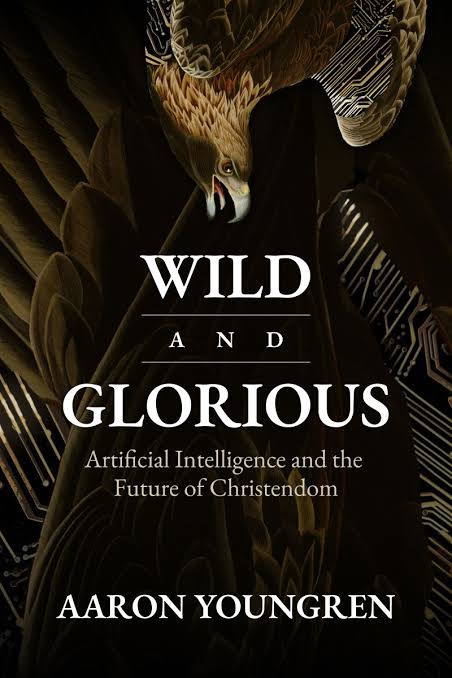
I just finished Aaron Youngren’s Wild and Glorious, and enjoyed the way all three views are represented therein (that is, avoidance, adoption, and balance). In fact, I think his thesis requires such representation. Youngren’s thesis is that man-made intelligences[1] are wild by design, and so a one-size-fits-all approach doesn’t work.[2]
By “wild” he means that though AI models may be trained to follow a predictable pattern of behavior, they may still do unpredictable things, like other forms of intelligence (i.e. animals, insects, etc.). A dog may act in the way it has been trained most of the time, but you still never know for certain. Youngren cites several examples from nature, concluding that such wildness is not a design flaw, but a feature, and then applies this principle to man-made intelligences. Their wildness he argues, “is a design feature, and this design feature is the key to understanding their proper use.”[3]
Because man-made intelligences are wild, there’s not a one-size fits all rule to govern their use. Wisdom is required. The only thing close to a generic rule Youngren proposes is the following: “Wild things require wise people. Intelligences are wild. Therefore we must become wise.”[4]
Youngren argues that some paths to wisdom must be pursues totally unaided by technology. Hiding God’s Word in our heart. Trusting in God’s Word. Spending time in God’s house. Attending to the work of training up children in the fear and admonition of the Lord. He also mentions learning, reading, developing skills, and becoming masters in our vocation.
In other words, all the things that man-made intelligences seek to remove from our lives (like the need to read and work), we need to double down on. If no one knows how to synthesize an argument from a book, but only to tell a chatbot to “summarize the author’s thesis,” how will we know if the information we are being fed is accurate? This example can be used in almost any line of work. Thus, Christians must be people who do the difficult work of growing in wisdom, skill, and understanding before we attempt to wield a tool that requires wisdom, skill, and understanding for appropriate use.
However, the pursuit and application of wisdom does not require absolute avoidance. Yes, we must avoid man-made intelligences in many instances to become wise. But in other ways, we can exercise wisdom in the use of such intelligences. Like animals, their wildness can also be harnessed and used in was that are glorious. Youngren uses the example of using an ox to plow a field in Exodus 21. It is wise to use an ox, even though it makes a mess, and even though it may gore someone, because it increases the production of the field. But just like an ox, the user of AI must be away that “he’s using reins to operate, not a steering wheel.”[5]
At this point, many techno-prophets would laugh at the possibility of using reins to harness the power of Artificial Intelligence. AI, they tell us, will become a super-general-intelligence, far surpassing the human species and capable of doing most things better and faster than we can, which could lead mankind into servitude or extinction (this is basis for many of the current calls for guardrails).
Yet Youngren says this is impossible. Mankind is the pinnacle of God’s creation. We are the only beings made in his image (Gen 1:27). The assertion that we can create something more glorious than ourselves is an assertion that we can create better than God.[6] We can’t. Ironically, we have reflected our image-bearing by creating intelligences. But we are still the creators. AI is the creation. We may have made it in our image, but we have been created in the Creators image. So we must recognize our place in the hierarchy of things.
Of course, human-made intelligences may get more and more powerful as tech giants seek optimization and profit, and there may be some really difficult side effects along the way (Youngren doesn’t discount such possibilities), but they cannot and will not become more glorious than the people God Himself created. We have been given dominion, not they. AI will serve us, not the other way around.
It is at this point that I would have liked Youngren to discuss if and how the current state AI can serve Christians. Much of his book dreams about transforming AI and making it “Christian.” But it is not currently so.[7] So should Christians currently use it? If so, how? If not, why not? My assumption is that Youngren encourages wise use of AI as it currently is, but I would have preferred him to say so explicitly, and to give some advice on how Christians can wisely use the current state of artificial intelligence.
Nevertheless, Youngren’s outlook on AI and how it fits into the Christian worldview is encouraging and challenging. He gives a charge in the final chapter, “What is needed today is not caution. What is needed is conquest. We shouldn’t wonder how Christianity will fit into this new world of man-made intelligences. We should ask how man-made intelligences fit into our world. Into Christ’s.”[8]
It is in this attitude of dominion and conquest that Youngren concludes his arguments for how Christians should engage with AI. He recognizes that there will be many pitfalls, and that landmines abound, but urges believers to dream big regarding how they can use and transform Artificial Intelligence. AI is built on words, Youngren says, and “words are ours.” I agree wholeheartedly, but would also like to see some tangible examples, even if they are hypothetical. In what ways can we use words, which are ours, to use, transform, and conquer AI?
Youngren calls the Christian to conquest through wisdom, not avoidance through fear. Could AI be another printing press, that helps spread the gospel and transform the world? Let’s hope so. And let’s become wise people, who through dependence on God, make it happen!
[1] Youngren uses the word intelligence to describe the way AI “thinks”, processes, predicts. AI is not intelligent in the same way humans are. AI is not conscious, does not have feelings, can’t have deep understanding (“how does an apple taste?) This does strengthen his comparison between AI and other intelligences, such as animals, however. They can process, learn, adapt, predict, all without being consciously self-aware.
[2] In the same way that a one-size-fits-all approach to hunting a wild animal doesn’t suffice. You have to observe, learn, adapt.
[3] Youngren, Wild and Glorious, 45.
[4] Youngren, 54.
[5] Ibid., 81.
[6] There’s a great section in ch. 27, “The Impossible Singularity” in which Youngren dispels many of the current AI myths such as “ Artificial Intelligence will learn to make itself smarter, decide that humanity is unnecessary, and kill or enslave us all.” I highly encourage you to read the book for this chapter alone!
[7] And it should be questioned, ‘Will it ever be so?’ Is the Internet Christian? Will it ever be? If so, should Christians use it in the interim? If not, should we ever use it?
[8] Youngren, 133.

