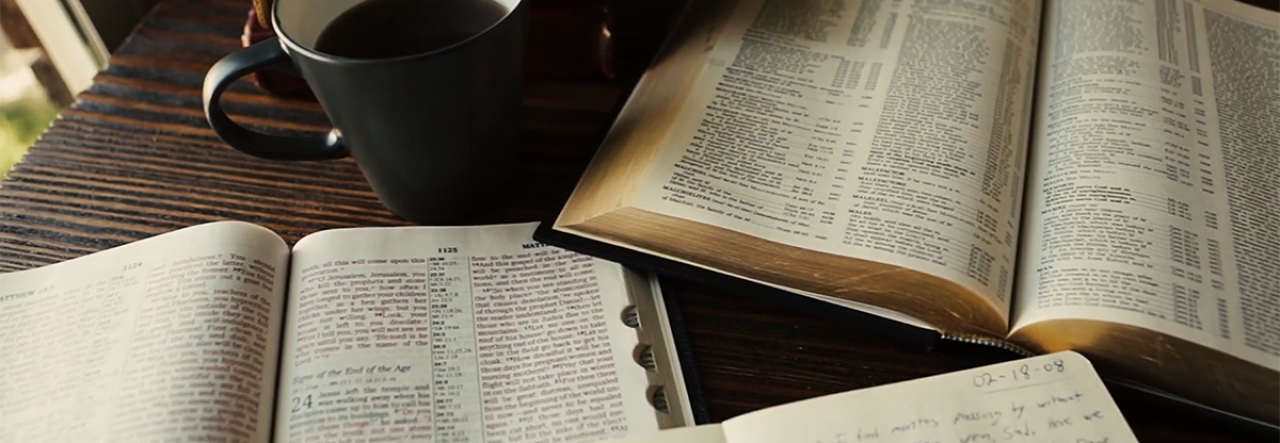
Old Testament Wisdom for New Testament Believers (Proverbs 4:23-27)

“The beginning of wisdom is this: Get wisdom ” (Proverbs 4:7a). If you want to be wise, get wisdom. Pretty simple, isn’t it? The entire book of Proverbs is filled with wisdom. So get the book, there you go- wisdom! But if you’ve ever read the book of Proverbs, you know it doesn’t come that easily.

Proverbs is a part of the rich wisdom literature of the Old Testament. Such literature is not conducive to interpreting at face value and immediately applying it to our lives. We have to slow down and understand the individual proverbs in their original context. We have to read them through the lens of biblical theology, and then apply them to the current context of our lives as New Testament believers.

In this message I want to help us “get wisdom” by studying a passage of Proverbs in the ways I just mentioned. Our text will be Proverbs 4:20-27,

Continue reading “Old Testament Wisdom for New Testament Believers (Proverbs 4:23-27)” →

The Fear of God and the Blessing of Family

This will be a short post, but I want to give it a permanent place on my blog. One of the unexpected blessings I continue to receive as a pastor is the privilege of attending funerals of saints who have finished the race well. I have already been to one such funeral this week and will attend one more this weekend. These funerals remind me of what is important in life, namely faith and family (including both blood-relatives and church family).

At the funeral for Mr. Roy Ellis, a member of our church for over six decades who had five children, ten grandchildren, and seventeen great grandchildren, Psalm 128:1-4 was read:

“ Blessed is everyone who fears the Lord,

who walks in his ways!

You shall eat the fruit of the labor of your hands;

    you shall be blessed, and it shall be well with you.

Your wife will be like a fruitful vine

    within your house;

your children will be like olive shoots

    around your table.

Behold, thus shall the man be blessed

    who fears the Lord.”

Here’s what struck me as this verse was read in honor of this faithful husband, father, grandparent, and church member: God’s blessing for fearing Him is described in the context of the family. In other words, God desires to bless the man who walks in His ways, and one of His greatest blessings in life is family and enjoying God’s blessings with them. This blessing entails enjoying the fruits of one’s labor (v.2), but not for one’s self, but with his family- a fruitful wife and many children (v. 3). “Thus shall the man be blessed who fears the Lord.”

This, I believe, is the lesson, especially to men: don’t overlook the blessing of family. Don’t overlook the blessing of a wife. Don’t overlook the blessing of children. Rejoice in them, and praise God for them. THEY are His blessings to you. Be encouraged by this, and labor all the more to fear the Lord and walk with Him so that you may share the fruit of that labor with them!

Five Ways to Invest in Disciple-Making Relationships

In my previous post, I contended that discipleship must take place in the context of relationships. But how do we create and invest in relationships with those whom we intend to disciple? Here are a few ideas:

1. Pray for them.

One of the most important things you can do in any disciple-making relationship is to pray for that person. It blesses the person as well as your relationship with them. As we take people before God in prayer, our hearts become invested in their spiritual well-being. We look for evidence of God’s work in their lives; we want to see it and be a part of it!

2. Pray with them.

Don’t just pray for the people you are discipling. Pray with them. As you do, you will be modeling what it looks like to pray. Remember, much more is caught than taught in disicipling relationships! Prayer will also unite your hearts as you spend time together in God’s presence.

3. Spend time together.

For any relationship to grow, you must spend time together. There will be times when you meet for “official” discipleship meetings, but don’t stop there. Invest in the relationship outside of set meeting times. Invite whoever you’re mentoring to join you in normal life activities: eating, running errands, playing with the kids, going to get ice cream, etc.

Recently, I needed to dig a hole for a new basketball goal, so I asked one of the guys in my discipleship group to come over one morning and help me dig the hole. After we finished, we sat in lawn chairs and admired our work as we talked about life. Another guy from my group came the next day and helped me mix concrete set the goal in place (it wasn’t easy, mind you, so we had to persevere together!). In each situation, I was able to spend quality time with these guys and strengthen our relationship.

Continue reading “Five Ways to Invest in Disciple-Making Relationships” →

Discipleship Happens in Relationships

Discipleship is an integral part of the believer’s life and a necessary component of any local church’s ministry. However, discipleship can be easily misunderstood and become a sort of grey, ambiguous term, something that we all know we should be a part of but we aren’t sure how. We know that Jesus invites us to be disciples and commands us to make disciples, but we don’t really know what that looks like. So what does it look like? Relationships. Relationships with the purpose of growing in Christ.

Let me start by defining terms. Discipleship is the process of following Jesus. Disciple-making is the process of helping people follow Jesus. This is primarily done through relationships. Disciples are not made via online sermons, curriculum, or printed books. They are made through participation in the body of Christ, especially through participation in relationships.

Continue reading “Discipleship Happens in Relationships” →

The Necessary Attitude of Sunday Expectancy

What should our attitude be towards Sunday worship? I’ve been pondering this question as I prayer walk around our church campus this morning. Unfortunately, one of the attitudes I sense the most is one of reluctance. People don’t really want to be there, but they know other people expect them to be. They believe that good Christians should go to church, and so they go, doing the bare minimum while they’re there. This attitude often leads people to be there physically without being engaged spiritually.

Others may not have an attitude towards Sunday worship at all. They just go. It’s a habit. Like robots carrying out a programmed task, they wake up, go to church, shake some hands, maybe even give an offering, and return home. No negative attitude, but not necessarily a positive one, either. Status quo. Go with the flow. Whatever it may be, wrong attitudes (or lack of right ones) do not glorify God, lead to spiritual growth, or bless fellow believers. Therefore, we need to fight for the right attitude towards Sunday worship. I believe one of those attitudes to be an attitude of expectancy.

Continue reading “The Necessary Attitude of Sunday Expectancy” →

How to Store Up Treasures in Heaven (Matt 6:19-24)

We are natural accumulators. We get and want more, so we get more and then want even more. This is true even at the subconscious level of the human mind. It is a proven fact that when we inhabit a space, whether it is a 2,000 sq. ft home or an 8,000 sq. ft home, we will accumulate enough things to fill the space whether we need those things or not. This is why Netflix series like ‘Tyding Up’ with Marie Kondo entice us. They promise to help us break free from the enslaving cycle of accumulation. The modern ‘minimalist’ movement seeks to do the same. These solutions are temporary at best, acting as band-aids on a fatal wound. But for those who want true freedom from the harsh master of materialism, there is hope in the words of Christ.

Continue reading “How to Store Up Treasures in Heaven (Matt 6:19-24)” →

A Secret Spirituality that Shines: Living for God and Not for People (Matthew 6:1-18)

In the Sermon on the Mount, Jesus describes the righteousness that characterizes the members of His kingdom. Is a divine righteousness that only He can work in the hearts of His people by the power of the Spirit. It is a righteousness altogether different than that of the religious leaders of the day. It is the righteousness of the redeemed heart that is evident in the words and actions of one’s life. It includes loving one’s enemies, reconciling friendships, making peace, giving generously, and going the extra mile.

In Matthew 5:16, Jesus commands[1] His followers to let their light shine before others, so that people may see their good works and give glory to the Father in heaven. Throughout the rest of Matthew 5, He describes what these good works look like in the context of personal relationships. However, He knows the human heart. He knows that as we progress in righteous living, we will begin to desire glory and praise for ourselves. Thus He warns, in 6:1 “Take care not to practice your righteousness in the sight of people, to be noticed by them; otherwise you have no reward with your Father who is in heaven.”

Continue reading “A Secret Spirituality that Shines: Living for God and Not for People (Matthew 6:1-18)” →

What Every Christian Should Believe About the Bible

Transcript: We are beginning a new series called What We Believe, where we will be going through eleven different sections of the Baptist Faith & Message, the confession we ascribe to as a member of the Southern Baptist Convention. Last week we explained why we are a Southern Baptist Church and gave a brief history on the use of confessions in church history and specifically the Baptist Faith and Message.

By way of review, confessions are written statements of faith that seek to clearly state what the Scriptures teach. Most confessions have sections on Scripture, God, Salvation, The Church, and so on. They are very useful because they summarize what the Bible teaches on a given topic in a clear and concise manner. These summaries can foster unity and provide doctrinal fidelity among church members, church associations, mission organizations, seminaries, etc. But they can also serve as teaching material. That is why we are using our confession of faith as the basis for a series on what we believe.

Why should we study what we believe? Because there is no graduating beyond the foundational truths of Christianity. We need to be constantly reminded and nourished by the tenets of our theology. They encourage us, enliven us, and give us confident assurance in every season. Without knowing what we believe, we will be like a ship without a rudder, tossed around by every faddish trend or belief system. In fact, one such trend in the church is to downplay the importance of doctrine and theology and focus on the practice of Christianity. Such a trend leaves its church members like cut flowers in a vase- they may look alive for a while, but they will wither and die for lack of roots.

We also need to know what we believe so that we can communicate those beliefs with others. It is very difficult to teach someone something that you don’t know much about. ‘Others’ may include your children, family members, other church members, your neighbors, and even strangers. Our task is to make disciples of all nations, teaching them to obey all that Christ taught us. How can we do that without knowing what He has taught us?

I could go on, but for the sake of time, I am going to assume we’re in agreement on the necessity of studying What We Believe. Tonight we are going to begin with the foundation of all our beliefs, including the foundation of confessions like these: the Word of God.

As we expound this article of the BFM, I want you to consider these questions: What is it that I believe about the Bible? Do my beliefs match our confession? And then: Does my life reflect my beliefs? That is where the rubber meets the road. Let’s begin.

Continue reading “What Every Christian Should Believe About the Bible” →

Three Areas Where God Calls Us to Invest Our Time

In today’s world, distractions abound. Phones, social media platforms, sporting events, and advertisements compete for our attention. Once they have our attention, they begin to clamor for our time. Soon, we begin investing large amounts of time on these platforms, at these events, or watching these shows. Yet God has called us to invest the majority of our time in three primary areas:

  1. Our relationship with Him.
  2. Our relationship with the people in our lives (family, church, friends).
  3. Our life of work.[1]

Are we spending the majority of our time investing in these three areas? If not, what distractions keep us from them? There are only twenty four hours in a day, seven days in a week. If we invest time in one place, it inevitably detracts from the time we can spend in another. Too often we become distracted and end up mindlessly investing our time in things that do not matter. Not only do they not matter, but they take time away from the things that do matter. We can’t have our cake and eat it too. That’s why Paul tells us to make the best use of our time (Ephesians 5:15-17).

Continue reading “Three Areas Where God Calls Us to Invest Our Time” →

Russia, Ukraine, and the Reality of Right and Wrong

Just about every morning I wake up and think about the people of Ukraine. Though I try to avoid looking at my phone for the first hour of the day, I have been waking and checking it regularly, eager to read of new developments. This morning I listened to Albert Mohler’s edition of The Briefing, which reminded me of a peculiar trend I have seen in the media. The trend is this: individuals, countries, and organizations are almost all unified in their denunciation of Russia’s wrongdoing. This collective condemnation raises the question: does this mean there is such a thing as right and wrong?

In the last few decades, post-modern thought has trained societies to reject moral absolutes (i.e. concrete, black-and-white claims of right and wrong). In fact, many assert that any claim to moral authority or to a recognition of moral truth is simply a tool of power and oppression (critical theory). Thus, what is right for you may not be right for me. What is true for you may not be true for me, and so on. A rejection of moral absolutes may be able to survive in the petri dish of theoretical frameworks, but it cannot survive in war-torn reality.

Continue reading “Russia, Ukraine, and the Reality of Right and Wrong” →