Old Testament Wisdom for New Testament Believers (Proverbs 4:23-27)

“The beginning of wisdom is this: Get wisdom ” (Proverbs 4:7a). If you want to be wise, get wisdom. Pretty simple, isn’t it? The entire book of Proverbs is filled with wisdom. So get the book, there you go- wisdom! But if you’ve ever read the book of Proverbs, you know it doesn’t come that easily.

Proverbs is a part of the rich wisdom literature of the Old Testament. Such literature is not conducive to interpreting at face value and immediately applying it to our lives. We have to slow down and understand the individual proverbs in their original context. We have to read them through the lens of biblical theology, and then apply them to the current context of our lives as New Testament believers.

In this message I want to help us “get wisdom” by studying a passage of Proverbs in the ways I just mentioned. Our text will be Proverbs 4:20-27,

Continue reading “Old Testament Wisdom for New Testament Believers (Proverbs 4:23-27)”

Ten Reasons to Read God’s Word Regularly

Every follower of Jesus should cultivate the habit of regular Bible reading. Here are ten reasons why.

  1. God’s Word leads us to salvation.

In 2 Timothy 3:15-17, Paul tells Timothy to continue in the “sacred writings” that He has known from birth. Paul is referring to the Scriptures, which he describes as being “able to give wisdom that leads to salvation through faith which is in Christ Jesus.” The Scriptures lead us to Christ, in whom is our salvation. But the Scriptures also continually point us to Christ throughout our lives and remind us of the gospel. We need to be reminded of what God has done for us in Christ on a regular basis. That’s why Paul encourages Timothy to continue reading them- and why we should to!

Continue reading “Ten Reasons to Read God’s Word Regularly”

What Every Christian Should Believe About the Bible

Transcript: We are beginning a new series called What We Believe, where we will be going through eleven different sections of the Baptist Faith & Message, the confession we ascribe to as a member of the Southern Baptist Convention. Last week we explained why we are a Southern Baptist Church and gave a brief history on the use of confessions in church history and specifically the Baptist Faith and Message.

By way of review, confessions are written statements of faith that seek to clearly state what the Scriptures teach. Most confessions have sections on Scripture, God, Salvation, The Church, and so on. They are very useful because they summarize what the Bible teaches on a given topic in a clear and concise manner. These summaries can foster unity and provide doctrinal fidelity among church members, church associations, mission organizations, seminaries, etc. But they can also serve as teaching material. That is why we are using our confession of faith as the basis for a series on what we believe.

Why should we study what we believe? Because there is no graduating beyond the foundational truths of Christianity. We need to be constantly reminded and nourished by the tenets of our theology. They encourage us, enliven us, and give us confident assurance in every season. Without knowing what we believe, we will be like a ship without a rudder, tossed around by every faddish trend or belief system. In fact, one such trend in the church is to downplay the importance of doctrine and theology and focus on the practice of Christianity. Such a trend leaves its church members like cut flowers in a vase- they may look alive for a while, but they will wither and die for lack of roots.

We also need to know what we believe so that we can communicate those beliefs with others. It is very difficult to teach someone something that you don’t know much about. ‘Others’ may include your children, family members, other church members, your neighbors, and even strangers. Our task is to make disciples of all nations, teaching them to obey all that Christ taught us. How can we do that without knowing what He has taught us?

I could go on, but for the sake of time, I am going to assume we’re in agreement on the necessity of studying What We Believe. Tonight we are going to begin with the foundation of all our beliefs, including the foundation of confessions like these: the Word of God.

As we expound this article of the BFM, I want you to consider these questions: What is it that I believe about the Bible? Do my beliefs match our confession? And then: Does my life reflect my beliefs? That is where the rubber meets the road. Let’s begin.

Continue reading “What Every Christian Should Believe About the Bible”

The Center and Core of the Whole Bible

I’ve been reading through Ned Stonehouse’s biography of J. Gresham Machen, the conservative New Testament professor at Princeton Seminary who stood against the liberal theology that was making inroads in the Presbyterian Church of America in the 1920s and 1930s.

Throughout the Book, Stonehouse highlights key sections from Machen’s works. In one of them, titled What is Faith?, Stonehouse recounts where Machen clearly sets forth what he believes to be the “center and core” of the whole Bible: the grace of God. And I couldn’t agree more. He writes,

Continue reading “The Center and Core of the Whole Bible”

Confidence in the Text

We have been working through the book of Jonah in my Hebrew class, and this week we discussed several nuances in Hebrew that are tough to see in our English translations. The question was asked, “how do we show these differences when we teach or preach?” Our professor gave a response that caused me to reflect on one of the greatest privileges of seminary: gaining confidence in the text of the Bible.

Continue reading “Confidence in the Text”

Six Key Benefits of the Necessary Evangelism Component in Discipleship

Yes. I am afraid. Every time I begin to share about Jesus with someone, millions of thoughts run through my head about how I may offend or be received wrongly. Have you ever felt the same?

This is the log jam in the discipleship process and to fulfilling the Great Commission: evangelism. Sharing our faith. Why? Often times it is because we haven’t seen it modeled, or haven’t been taught “how.” Even in our rigorous attempts at discipleship have not fixed the problem, because discipleship has come to be regarded as a practice without the necessary component of evangelism training or practice. However, treating evangelism as a necessary part of discipleship helps to grow mature disciples, and is absolutely necessary. I read a great article recently highlighting 6 reasons why. Here they are: Continue reading “Six Key Benefits of the Necessary Evangelism Component in Discipleship”

My Gentle Wife & God’s Chisel

“…let your adorning be the hidden person of the heart with the imperishable beauty of a gentle and quiet spirit, which in God’s sight is very precious.” 1 Peter 3:4


marriagephoto

My wife is a quiet and gentle woman; I am not a quiet and gentle man. I want to be. I pray daily to be…but I am constantly acting in pride, selfishness, and harshness. I grieve these sins, because I know they grieve my Master. But thank goodness, my God has given me an amazing wife-a daily reminder, and frequent conviction, to pursue gentleness, and to be slow to speak, slow to anger, and quick to listen. Continue reading “My Gentle Wife & God’s Chisel”

Discovering The True Jesus (pt.3)- The Birth of a Savior

For unto you is born this day in the city of David a Savior, who is Christ the Lord. And this will be a sign for you: you will find a baby wrapped in swaddling cloths and lying in a manger.”   Luke 2:11-12

The virgin birth. In America, most of us hear this story every year during the Christmas season, so much so that I believe we have become calloused to the extraordinary way that Jesus entered into our world. The Bible teaches that Jesus was conceived by the Holy Spirit in a virgin named Mary. The angel Gabriel tells Mary, “behold, you will conceive in your womb and bear a son, and you shall call his name Jesus.”

Often times, we think of Jesus starting His whole life as an infant, but the Bible also teaches that He existed with the Father for all of eternity past. In the book of John, the author describes Jesus as the “Word,” stating that He was with God the Father in the beginning, and that God created all things through Him (John 1:1-3). God says before He creates man, “Let us make man in our image” (Gen 1:26). So, lets think briefly about the transition from Jesus’ life in heaven to His “birth” on earth….what do you think it was like?

Hard to think about, isn’t it? Thankfully, in Philippians, the author lays out for us what Jesus did when He chose to come to earth:”Christ Jesus, who, though he was in the form of God, did not count equality with God a thing to be grasped, but emptied himself, by taking the form of a servant, being born in the likeness of men” (Phil 2:5-7). Jesus completely humbled himself in leaving his heavenly throne to come live as one of us….to ultimately die for us and save us. He was born in the likeness of men, so that He could be the perfect sacrifice for men.

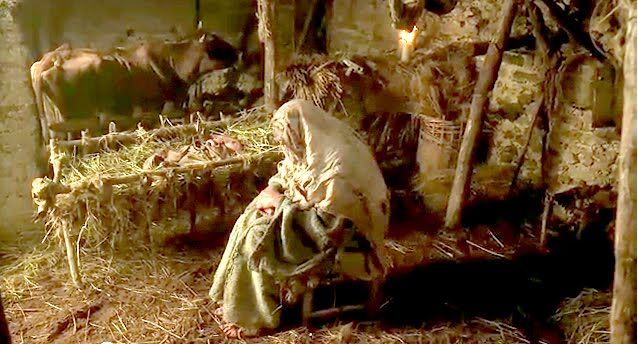
Speaking of Jesus’ humbling himself, look at where He was born! In our first text in Luke, we saw that it was said that Jesus would be found lying in a manger. A manger is a feeding trough used to feed farm animals. It was in the center of the holding houses and likely the dirtiest part of the barn. When animals eat…they often relieve themselves in the same spot. This is likely what the scene actually looked like:

manger

Jesus, the Son of God, came into the earth and spent His first few minutes on earth in one of the dirtiest environments. Why? Humility. Jesus humbled Himself, remember? Is this the way for an earthly King to enter the world? Certainly not. But we will learn of Jesus throughout our study, that He does nothing like an earthly king would do. “My kingdom is not of this world” Jesus says in John 18:36. But I also believe that this was God’s way of showing that Jesus was the real deal. Jesus was humble and a servant from the get-go. He was willing to do whatever it takes to complete His purpose, and in this case-that meant being born in a dirty manger.

The last piece of this story that I want to unfold is: why was it necessary for Jesus to be born of a virgin?

All throughout the Bible, God required a perfect sacrifice to be made before Him to pay for sin committed. In the Old Testament, God’s law required His people to sacrifice “unblemished” lambs, bulls, and goats. If the sacrifice wasn’t perfect before God, it was unacceptable. In the same way, for Jesus to be the perfect and final sacrifice, He must be perfect and unblemished before God. Ever since Adam sinned in the garden, every human being has been born into sin, and the Bible depicts sin nature passing down from generation to generation through the father (Romans 5:12,17,19). It was critical Jesus not to be “born in sin” so that He could fulfill His role as the perfect sacrifice. This is why the Holy Spirit conceived Jesus in Mary’s womb, so that Jesus could circumvented the transmission of the sin nature and become a perfect man.

This little story has more depth than you thought, didn’t it? Its read every year at Christmas, but certainly worth celebrating the entire year. It marks the beginning of Jesus’ life on earth, and is absolutely crucial to the fulfillment of the rest of His mission. Jesus wasn’t only born in a dirty manger, but He would die on a bloody cross.

Tune in next week for part 4 of this series.

Seeing the Goodness of Our God

Topaz-Waters-beautiful-nature-21888528-1217-812

The more closely we study ourselves, the more beneficent our Creator becomes. Look at the highest of God’s earthly creatures-man. We have plenty of reasons to say with the Psalmist, “I will praise you, for I am fearfully and wonderfully made: marvelous are your works; and that I know full well” (Psalm 139:14). Everything about the structure of our bodies attest to the goodness of our Maker. How suited are our hands to perform work! How good of the Lord to appoint sleep to refresh our wearied bodies! How benevolent His provision to give to the eyes lids and brows for their protection! We could continue indefinitely!*

The goodness of God is also seen in the variety of natural pleasures that He has provided for his creatures. God could have decided to satisfy our hunger without allowing us to really enjoy the taste of it- yet how good is He that he gave us such flavors as those in meat, vegetables, and fruits! He has not only given us senses, but also things that will gratify our senses, and this too reveals His goodness. The earth could have been fertile as it is without its surface being so delightfully multicolored. Our physical lives could have been sustained without beautiful flowers to please our eyes with their colors, and our nostrils with their sweet perfumes. We might have walked outside without hearing the music of birds. Why then, is all of this loveliness so freely diffused over the face of nature? Because the tender mercies of the Lord “are over all His works” (Psalm 145:9).*

When others behave badly to us, it should only stir us up the more heartily to give thanks unto the Lord, because He is good; and when we ourselves are conscious that we are far from being good, we should only the more reverently bless Him that He is good. We must never tolerate an instant’s unbelief as to the goodness of the Lord; whatever else may be questioned, this is absolutely certain, that Jehovah is good; His dispensations may vary, but His nature is always the same (C.H. Spurgeon).

Gratitude and thankfulness is the return justly required from us, the objects of His goodness. Yet we often do not give it to God because His goodness is so constant and so abundant. It is lightly esteemed because it is exercised toward us in the common course of events. It is not felt because we daily experience it!* We must labor to not allow this to be so!

Praise the Lord for His Goodness!!

*My translation from A.W. Pink’s “Old” English language (Attributes of God, Ch. 11, The Goodness of God)