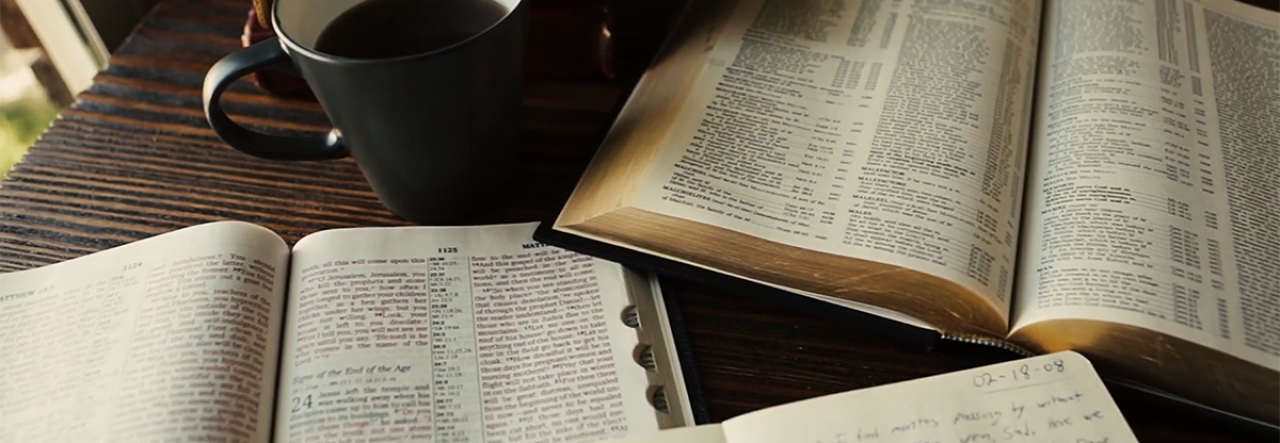
This week we are considering the question of whether or not we can trust the Bible. What makes it unique, setting it apart from other religious books? How can we be sure that what we have is what was originally written? And how can we know that it is actually from God?
A quick reminder: we are not looking for absolute certainty. We are looking for confidence. Can we have confidence that God has spoken to us in the sixty six books of the Bible? Here are six reasons that I believe we can.
1. The Unity of Scripture
The Bible was written over 1,500 years by over forty authors in three languages on three different continents, yet it tells one cohesive story about God and man. All of the Bible from Genesis to Revelation centers upon the Son, the Seed, the Servant, who will save his people from their sins and reconcile them to God. His victory is promised in the first book of the Bibe and is realized in the final book of the Bible. How amazing is it that all of the biblical authors, in different languages, in different centuries, write in such unity with each other?
2. The Explanatory Power of Scripture
This unifying story is an apologetic in and of itself. It answers all the biggest questions of life: How did we get here? Why are we here? Why is the world the way that it is? Why is there suffering, pain, and death? What hope is there for us? What should we live for? What comes after this life?
The Bible possesses the greatest explanatory power for all of the major questions of life. It explains who created us, how sin entered the world, why we experience pain and suffering, and how God, in his mercy and love, has purposed to save us in His Son and redeem us from all the effects of sin. It explains to us who God is- the One in whom we live and move and have our being. It gives explanation to life in a way that nothing else can.
3. Fulfilled Prophecy
At many points in this unfolding story, God speaks through prophets who specifically predict future events. Some of them are so accurate in their predictions that liberal scholars claim that the books must have been written after the events predicted (the book of Daniel, for example). A couple of these prophecies include Judah & Israel’s exile and captivity, Isaiah’s prediction of Cyrus leading the Jews home, and Jesus prophesying the destruction of the temple within a generation in Matthew 24.
However, the most impressive prophecies are those that are made about the Messiah that were fulfilled in Jesus of Nazareth. Conservatively, Jesus fulfilled over 300 prophecies from the Old Testament. Some of these include specific prophecies such as his birth in Bethlehem or his family fleeing to Egypt, but also include typological prophecies such as Abraham sacrificing his only son, Isaac. God tells Abraham to spare his son, of course, but the story points to God the Father sacrificing his Son, Jesus.
4. Historical Reliability
The first three reasons are impressive, but not if the story and prophecies have been edited and re-written over the centuries to make the Bible appear more impressive than it is. Can we be confident that what we have in our modern Bibles is what was actually written thousands of years ago? Yes we can.
We have greater historical evidence for the Bible than any other work of antiquity. In seminary, I focused on the work of textual criticism. I was able to compare several different manuscripts (copies) of the New Testament and evaluate their similarities and try to make sense of their differences. Get this: we have well over 5,000 copies of the Greek New Testament, and some of those copies go all the way back to within 30-50 years of the originals. And these copies agree 93-95% of the time!
There are, of course, minor differences between the copies. They were all handwritten copies, so we should expect differences to appear. We call those differences variants. But the vast majority of the text of the New Testament has been miraculously preserved through centuries of copying. When we put the copies side by side, the original (what we call the autograph) emerges, and we can be confident that we have what was originally written.
5. The Preservation of Scripture
This kind of manuscript evidence is unheard of in antiquity. Thousands of scribes worked meticulously to preserve God’s word for us and passed it down from generation to generation. And God saw to it that it was preserved! Not only did the Holy Spirit inspire the Word of God, but preserved the Word of God for us through the centuries.
The fact that what we read in our modern Bibles is what was originally written thousands of years ago is another reason to trust God’s Word. We aren’t placing a blind faith in a book was written by one man, has an ambiguous beginning, or that we know was tampered with and changed throughout the centuries. We can be confident that we have the God-inspired Word that he wrote and preserved for us. “Heaven and earth will pass away, but my words will by no means pass away” (Mark 13:31).
6. The Testimony of Transformed Lives
Notice that we didn’t start with this one. To a skeptic, the reality of a changed life isn’t a strong apologetic. If a Buddhist told you how much meditation changed their life, would you be compelled to believe in its merits? Perhaps a little, but their testimony alone wouldn’t convince you.
But when coupled when the above reasons, the transforming power of the Bible is certainly a meaningful apologetic. Entire lives, families, and even nations have been transformed by the Bible and the gospel it proclaims. Have you experienced this in your own life? Has the Spirit stirred a love in your heart for God’s Word? Has God’s Word changed you?
“Sanctify them in truth. Your word is truth,” Jesus said John 17:17. The means of our transformation into godliness is the Spirit working through the Word. The Word of God sanctifies us. It tills the soil of our hearts, plants the seeds of holiness, and brings godliness to fruition. The impact it makes on individuals and communities is a testimony to its divine power!
His word is trustworthy and sure; it is living and active (Heb 4:12). As Spurgeon once said, “The Word of God is like a lion. You don’t have to defend a lion. All you have to do is let the lion loose, and the lion will defend itself.” I hope these reasons give you confidence to let the lion loose in your life!
 JARRETT FLETCHER
Beautiful ❤️
LikeLike
I love this. Thank you so much for sharing your God given gifts and talents with us. Hope it is alright with you as I intend on and can see me using this in many different capacities.
Prayers continue for you as you continue to heal from your surgery.
Sincerely, Lucy Hopson
LikeLike
Thank you, Lucy! Yes, please use however you see fit!
LikeLike
yes and amen
LikeLike