How to Build a Christian Home and Career (Colossians 3:18-4:1)

My last post considered the admonition for us to put off the grave clothes that adorned our old life and put on the grace clothes that befit our new life in Christ. In this week’s passage, Colossians 3:18-4:1, Paul continues the theme of Christian living in light of the theology and doctrine presented in the first two chapters. Specifically, he addresses two areas of the Christian life that provide the foundation for society as a whole: family and work. Here’s the text:

18 Wives, submit to your husbands, as is fitting in the Lord. 19 Husbands, love your wives, and do not be harsh with them. 20 Children, obey your parents in everything, for this pleases the Lord. 21Fathers, do not provoke your children, lest they become discouraged. 22 Bondservants, obey in everything those who are your earthly masters, not by way of eye-service, as people-pleasers, but with sincerity of heart, fearing the Lord. 23 Whatever you do, work heartily, as for the Lord and not for men, 24 knowing that from the Lord you will receive the inheritance as your reward. You are serving the Lord Christ. 25 For the wrongdoer will be paid back for the wrong he has done, and there is no partiality. 41Masters, treat your bondservantsjustly and fairly, knowing that you also have a Master in heaven (Colossians 3:18-4:1 ESV).

The Household

This section begins with instructions for wives and husbands. I believe Paul mentions marriage first because it is the foundation of the family, and therefore, of society. A husband and wife cannot obey the following verses regarding raising children if they are not pursuing a godly marriage. So, what does a godly marriage look like?

First, in a godly marriage, wives submit to their husbands (v. 18). Paul says that such submission is “fitting in the Lord.” The verb used here is in the middle voice, calling wives to willingly submit themselves under their husbands’ leadership.  In other words, they don’t try to usurp his role as the leader of the home. They don’t try to override the decisions he makes. They don’t disparage his leadership behind his back. Instead, they choose to follow his leadership as he follows Christ.

Such submission glorifies God because it exemplifies the Son’s submission to the Father. Though they are equal in deity and unified as one God, the Son submitted himself to his Father and his Father’s will. In 1 Corinthians 15, we see the Father putting all things in submission to his Son, but we also see the Son in submission to the Father. Jesus himself spoke of his submission in places like John 6:38, “For I have come down from heaven not to do my will but to do the will of him who sent me.”

A godly wife is one who recognizes that God calls her husband to lead her and be her “head” (Eph 5:23), and who encourages him in this role. She loves him, prays for him, and as he follows Christ, she follows him.

What does this look like in real life? Suppose a husband and wife move to a new city for work. They attend different churches and settle on two of their favorites. However, the church the husband believes is the best fit for the family is not the same church the wife thinks is the best fit. After much prayer and conversation, if they cannot come to the same conclusion, the wife should trust the leadership of her husband, follow him (willingly, not begrudgingly), and trust God with the results.

Second, in a godly marriage, husbands love their wives. Notice that husbands are not called to enforce the submission discussed in 3:18. They are not called to lord their authority over their wives; they are called to love their wives. In a parallel passage, Paul tells husbands to love their wives “as Christ loved the church and gave himself up for her, that he might sanctify her, having cleansed her by the washing of water with the word,” (Eph 5:25-27).

The husband’s role is to sacrifice himself for the highest good of his wife- her sanctification. He loves her by putting her first, caring for her spiritual needs, and providing for her emotionally and physically. This kind of love is a choice- it is not a feeling. It does not come natural to husbands, nor was it natural in the Colossians’ day. It is daily work. It is the conscious dying to self for the good of another, and repenting of selfishness when it creeps in.

Husbands, do you love your wives? Do you prioritize her spiritual health? Do you pray for her? Do you pray with her? Do you wash her with the word? Let me encourage you- find a place to start! Look for small ways to serve her. Let her hear you pray over her in the mornings or evenings. Be the one to begin spiritual conversations. Love your wife by leading your wife!

Continue reading “How to Build a Christian Home and Career (Colossians 3:18-4:1)”

The Ministry of the Mundane

1748-slide1


Do you ever feel like your days run endlessly together? Wake up, go to work, come home to innumerable chores, go to bed, repeat. Where is the abundant life God promised? Are you missing it? Is it possible to find purpose in the predictable and meaning in the mundane?

I (Jarrett) found this article earlier in the week, and I had to rewrite and repost it, because I think that every believer will be built up and edified through it!

If we are followers of Christ, the answer to the above questions are “yes,” for nothing done in surrendered obedience is ever wasted. At each moment, God uses our mundane, earthly experiences to train and equip us for something greater, to center our thoughts on the eternal, and to be active participants in his outpouring of love and grace. Living God’s great adventure is not a matter of location or vocation, but rather, a continual process of heart and mind transformation.

Continue reading “The Ministry of the Mundane”

My Gentle Wife & God’s Chisel

“…let your adorning be the hidden person of the heart with the imperishable beauty of a gentle and quiet spirit, which in God’s sight is very precious.” 1 Peter 3:4


marriagephoto

My wife is a quiet and gentle woman; I am not a quiet and gentle man. I want to be. I pray daily to be…but I am constantly acting in pride, selfishness, and harshness. I grieve these sins, because I know they grieve my Master. But thank goodness, my God has given me an amazing wife-a daily reminder, and frequent conviction, to pursue gentleness, and to be slow to speak, slow to anger, and quick to listen. Continue reading “My Gentle Wife & God’s Chisel”

The Heavenly Wedding Feast…Do You Have The Attire?

Image

In Matthew 22 Jesus speaks to the disciples in a parable that we regard as “the parable of the wedding feast.” He starts of by telling them that “the kingdom of heaven could be compared to a king who gave a wedding feast for his son..” (verse 2). He proceeds to tell them that the king sent out his servants to invite people, but the people would not come. He sent more servants to invite them to the wedding, but the people paid no attention to them, treated them shamefully and even killed them. He sends out new servants with new instructions, “Go therefore to the main roads and invite to the wedding feast as many as you find.” These servants gathered good and bad (a foreshadow that Gentiles would later have the gospel message offered to them, but more on that in a different post) people, and the wedding hall was filled with guests. But the king comes in and sees a man without the wedding garment and asks him, “Friend, how did you get in here without a wedding garment?” (verse 12). The man was speechless, and at once the king had him bound and cast into outer darkness.

If your like me, you may read this and think, “What in the world? The man didn’t have on the right clothing…so he was cast out? What about meeting people where they are and welcoming them into our churches no matter what?” These are the things that I thought before the Spirit revealed to me the much deeper meaning of the passage. Here’s the deeper meaning:

The wedding feast represents heaven, and the King represents God. The servants that go out and invite people (the Jews) represent God’s prophets in the Old Testament, that proclaimed repentance and prophesied about Jesus, but were treated badly and put to death.  The good and the bad people represents everyone else (because the Jews refused to respond). All of this so far may or may not be obvious, but what on earth does the poor man without the wedding garment have to do with anything? Well, he is truly a poor man, and I’ll tell you why:

The wedding garment represents Christ’s righteousness that is laid over us. This is the way that Jesus taught that our self-righteousness would never be enough! From the very beginning of creation, God has provided a “covering” for our sin. To insist on covering ourselves is to be clothed in “filthy rags” (Isaiah 64:6). Adam and Eve tried to cover their shame, but they found their fig leaves to be woefully scant. God took away their handmade clothes and replaced them with skins of animals (Genesis 3:7, 21). In the book of Revelation, we see those in heaven wearing “white robes” (Revelation 7:9), and we learn that the whiteness of the robes is due to their being washed in the blood of the Lamb (verse 14). We trust in God’s righteousness, not our own (Philippians 3:9)! The man who did not wear the wedding garment is an example of one who trusts in his own righteousness and merit to get into heaven! It simply cannot be done, if we try to do so, we will be cast into outer darkness.

The king provided wedding garments for his guests, and God has provided salvation for mankind through Christ! My friends, our wedding garment is the righteousness of Christ, and there is no wedding feast for us if we do not have it! When the religions of the world are stripped down to their basic tenets, we either find man working his way toward God, or we find the cross of Christ. Jesus crucified, buried and resurrected is the only way to God, for He himself says, “No one comes to the Father except through me” (John 14:6).

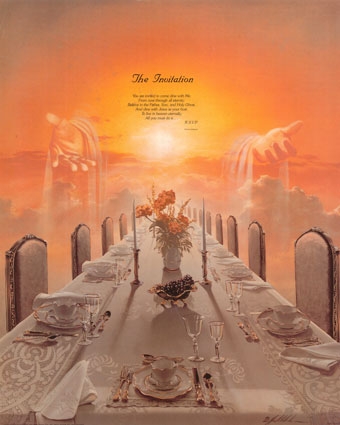
God has invited us to a wedding feast, and an eternity with him. Our invitation comes with a garment that we must receive and put on to enter: Christ’s righteousness. We do this by trusting in His life and finished work on the cross to cover our sins, without any bit of trust in our own merit or good works. If we trust in ourselves, our own righteousness, and our good works to gain us entrance to the feast, we wil be cast in to utter darkness: eternity in hell. However, the kingdom of heaven is opened to those who will set aside their own righteousness and by faith accept Christ’s righteousness.

My friends, there is a heavenly wedding feast awaiting, and your invited. The question is, do you have the attire?