Start The New Year Remembering Your Identity In Christ

As the new year begins, I believe that the church at large, myself included, needs to remember our identity in Christ- as it pertains to sin. If your like me, when you think about who you are in Christ-you often think of yourself as forgiven, loved, set-apart, saved, etc. These identities are very true and important, but God has reminded me early in this year of another aspect of my identity in Christ- dead to sin.

Paul writes in Romans,

We know that our old self was crucified with him in order that the body of sin might be brought to nothing, so that we would no longer be enslaved to sin. For one who has died has been set free from sin. Now if we have died with Christ, we believe that we will also live with him.” Romans 6:6-8

We as believers are told not only that Christ died for us (substitution) but that we died with Christ (identification). He not only provided the forgiveness of sins, he provided the deliverance from the enslavement of sin. Watchman Nee says, “Our sins were dealt with by the blood,we ourselves are dealt with by the cross.” The blood of Christ seals and provides our forgiveness (“without the shedding of blood there is no forgiveness of sins- Hebrews 9:22b); But the cross of Christ delivers us from what we are in Adam- slaves of sin!

You see, we were joined with Jesus on the cross. One may ask you, “who was crucified at Calvary?” Certainly most Christians would answer with Jesus, but how many would answer that we were crucified there with him, too? It is a beautiful fact–that we were united with Christ in his death and resurrection. We were united to him in death, as our old selves were crucified with him, and also united in his resurrection, as our new selves were given life!

Fellow believers, we are set free from sin! We are not only forgiven from our past, present, and future sins, but we are a new creature! (2 Cor. 5:17), able to have victory over sin, and to say “NO” to temptation. C.H. Spurgeon once said, “You cannot be married to Christ until you are first divorced from sin.” You may ask, “How can we be divorced from sin?” The answer is that Jesus provided the very divorcement papers! He declared us divorced when we were crucified with Him at Calvary.

Does this describe your walk with Jesus? Can you say that you have accepted this great truth by faith, and leaned on the Spirit to live by it? This is God’s desire for us: to trust in Christ, receive the forgiveness of sins, and to walk a new life in the Spirit, a life characterized by freedom from sin. Throw yourself upon Christ! Trust in Him! This was our greatest need- to be made dead to sin, and alive to God- and He perfectly provided for us. Our old self has been crucified, and our new self has risen with Christ in power. Will you join me in pursuing a life that lives out this identity this year?

Jesus: Giver of Living Water

At the very beginning of the story of the woman at the well, we see Jesus do something that yet again sets himself apart from most religious leaders at the time. We are told that he had to pass through Samaria (John 4:4). Most devout Jews would avoid Samaria on this journey to and from Judea, taking a much longer route, due to their racism and hatred of Samaritans. Jesus, however, walks right on through, and sits down for a divine appointment with a sinful Samaritan woman.

Jesus tells the woman,

“Everyone who drinks of this water will be thirsty again, but whoever drinks of the water that I will give him will never be thirsty again.” -John 4:14

The woman suddenly makes a request for this water, but she does not understand what Jesus is saying. This is clearly shown in the latter part of her sentence, “..so I will not be thirsty

Jesus came to quench the “thirst” of those longing to know God. He alone provides the “living water” for us to be in a relationship with God and be satisfied with Him forever!

To aid the woman’s misunderstanding, Jesus helps her understand who he is by telling her he knows of her five husbands (4:18) and prophesying that people will eventually be able to worship anywhere (because God will no longer dwell on a mountain or in a tabernacle, but in the hearts of believers). When the woman tells Jesus that she knows that a “Messiah” is coming, he responds with what would be an incredibly dramatic scene in a movie by saying, “I who speak to you am he.”

I trust that at once the woman knew who Jesus claimed to be, and she believed- she drank of the living water.

In verse 28 we are told, “So the woman left her water jar and went away into the town..”

She left her water jar! This is not astounding to 21st century readers as it should be, because we do not understand the difficulties of retrieving water. Most women in the 1st century would walk some great distance to fill their jars for the necessities that the day held: cooking, bathing, drinking, etc. Also, the fact that the woman came at approximately noon is a possible indicator itself that she felt ashamed and didn’t want to be seen in public (potentially due to her having 5 husbands)- which makes it all the more interesting that this is the woman that Jesus speaks to. Nevertheless, what we do know for sure is that the retrieval of water was a big deal-so to leave the jar behind and return to town without it-was a big deal!

This is to say that the most important thing in the woman’s life at the time was dropped when she encountered Jesus. I believe she understood that she had encountered something far greater than a necessity for this physical life- she encountered the necessity for a spiritual life in God- Jesus.

You see Jesus offers this living water to us, it is ours for the taking. To trust him, to drink of the water that he offers, to be brought in relationship with Him, and to never thirst again- is the offer on the table. Will you take it?

If you are dying of thirst in a desert and you stumble upon a pool of water, would you look at it? Would you admire it? Would you try to understand how it got there? Or how you stumbled upon it? Would you memorize its color and study it? No- You would drink it at once!

The woman not only left her jar, she ran into the town, among the people she was ashamed to be seen by, and emphatically told them about Jesus. Her previous worries of being mocked or looked down upon were gone! She knew who she had encountered- the King of the universe. You can encounter him, too.

My friends, please drink of this living water! Drop everything else your worrying or thinking about. Nothing is as important as this- Have you accepted Jesus? Have you drank of the living water? Throw yourself upon Christ. He is waiting to quench your everlasting thirst!

Please email me at jrfletch@uga.edu with any questions!

John 3 – “You Must Be Born Again”

Jesus was very clear about the change that must take place in order to become one of his own and see the kingdom of God.

You must be born again” John 3:7

Must I go to church? No, you must be born again. Must I pray a certain prayer? No, you must be born again. Must I give to the poor? No, you must be born again. Must I be baptized? No, you must be born again. Must I follow the law? No, you must be born again. Must I teach Sunday school or sing in the choir? No, you must be born again!

Truly, truly, I say to you, unless one is born again he cannot see the kingdom of God” John 3:3

One of my spiritual heroes, C.H. Spurgeon, illustrated this truth this way (in my own paraphrase):

Suppose that in England, there should be a law passed that admission to courts, preference to office, and any privileges in the nation were only given to the natural born citizens of the country. What then, would court officials say if an native Indian man came to them and said, “I will change my name” or “I will change my dress” or “I will change my family, my friends,” or “I will learn the language” or “I will work for it!” You see none of these things could admit the man, for the law is absolute, the man must be an natural born citizen to obtain the privileges, and he is not.

This illustration also correlates with us as Christians. We cannot change our names (call ourselves Christians), change the way we dress, change our friends, change our behavior, learn to talk like Christians, learn to pray like Christians, give away our money, help the poor, or do any type of Christian service. For God’s statement is clear: “You must be born again.”

This new birth is a sweeping process which is more than a change, it is a creation. Not just reformation, but regeneration. Not just becoming religious, but being born. 2 Corinthians 5:17 says, “Therefor, if anyone is in Christ, he is a new creation. The old has passed away; Behold, the new has come.”

Do you exhibit a different life than you did before? Do you now hate the very things you used to love? Have your desires changed? Do you have a hunger for reading and understanding God’s Word? Do you desire to be around other believers? Can you persist in sin? What is your attitude towards sin- are you brokenhearted over it? or are you still indifferent to it? To whom have you entrusted your whole life to?

We cannot bring about these changes ourselves, nor make ourselves “born again.” We are only born again of the Spirit, the power of God. Salvation is a magnificent work where a soul is saved and made completely new. Ultimately, Jesus is the only one who can bring about this new creation in us.

It is imperative to understand that he brings about this change. “Behold” says Christ, “I make all things new” (Revelation 21:5). Dear friend, you must be made new; you must be born again! I paraphrase Mr. Spurgeon again, “Christ can make you really pure in heart; he can make you a new creature, so that you shall be converted and become as a little child. “Oh!” say you, “how can I get it? How can I prepare myself for him?” You do not want to prepare yourself for him. Go to him just as you are; trust him to do it, and he will do it. That is faith, you know–trust, dependence. Can you believe that Christ can save you? Oh! you can believe that; well now, will you trust him to save you? Will you trust him to deliver you from your drunkenness, from your angry temper, your pride, your love of self, your lusts? Do you desire to be a new creature in Christ Jesus? If so, that very desire must have come from heaven. I could fain hope that he has already begun the good work in you, and he that begins it will carry it on.”

“”Oh! make me a new creature!” If you have said that from your heart, you are a new creature, dear brother, and we will rejoice together in this regenerating Savior.” (Spurgeon, A New Creation, published July 15, 1915.)

John 2: Jesus Turns Water To Wine: Amazing Symbolism

slide-8-water-into-wine

**Please note: I originally wrote the below post many years ago as a part of a project at the University of Georgia. I am leaving up the original post in case something in it may prove helpful to anyone. However, I have had the opportunity to teach on this subject more recently and I believe my latest presentation of this passage is more nuanced and substantive.

Here is a link to my more recent blog on this passage:

Why Did Jesus Turn Water Into Wine?

Most people have heard about Jesus turning the water into wine, but do they really know what it means? Do you really know what it means?

If you have not read this portion of scripture, please read John 2:1-12 now so that we may be taught of the Spirit together as we analyze this passage! This miracle of Jesus packs a deep meaning that radically sets the stage for the rest of his life, ministry, and purpose.

First, its important to know the setting for where He performed his first miracle. We see that he performs it at a wedding feast (John 2:1), one of the most treasured celebrations in 1st century Jerusalem. He is attending with his mother and a few of his disciples, and it is brought to his attention that there is no more wine to be served. To us, this doesn’t seem like a big issue, but the point of all Jesus’ miracles is to demonstrate spiritual truth, and what a amazing truth he reveals through this miracle!

Key Point: Jesus uses the ceremonial cleansing jars to create the wine. (John 2:6)

We need to note what Jesus used to turn the water into wine. He used ceremonial cleaning jars, which probably already had a decent amount of old water sitting in them. The Jews would use these water jars to purify themselves: to wash themselves, and make themselves “clean” before God. By using these jars, Jesus is giving us a sneak peek of what is to come. Jesus is showing us that the cleansing of His blood (as we know, in the Bible, the blood of Christ is represented by wine -Matt 26:28) is far greater than any ritual washings – and the transformation of this very water into wine symbolizes the transformation of Judaism.
The fact that Jesus changed the ceremonial washing water into wine proves that he will do away with the rituals of Judaism, and that we will be made clean before God through his blood. Jesus filled the containers to the brim (John 2:7) to show that no space is left for ritual washings after his sacrifice.

Jesus instructs the servants to take a pitcher of this water to the master, and so they did. We don’t actually know when the water turns to wine, but when the master of the feasts takes a sip, he says, “Everyone serves the good wine first, and when people have drunk freely, then the poor wine. But you have kept the good wine until now” (John 2:10). Is this recorded just to show us that Jesus should start a new career as a wine-maker? Certainly not. The Spirit is showing us something here:

The statement made by the master of the feast implies this: That typically, the best wine is served first, so that the people “get their fill” (get drunk) and can’t tell when a cheaper wine is introduced. In the same way, The Jews had been “drinking wine” (aka. performing their ritual washings) for so long that they weren’t able to recognize when something better came along (Jesus)!

Jesus conveys this truth again in the same chapter when he drives out the temple. He exclaims, “Destroy this temple, and in three days I will raise it up” (John 2:19). Jesus was talking about his own body, and it was through the “destroying of it” and his rising from the dead that was able to accomplish this new system, where his blood covers our sin, not our ritual washings or other works.

Jesus came to make everything new, and he clearly demonstrated that by turning old water used for bathing into brand new wine. He also came to make the heart new. We will see that tomorrow in John 3!

(please email me at jrfletch@uga.edu for further explanation or questions)

John 1: The Word Became Flesh

This year, my family, some friends and I are reading through the book of John counting down to Christmas. Each day we are reading a chapter and I am writing an analysis. Please join us! Today is John Chapter 1.

John 1

In the beginning was the Word, and the Word was with God, and the Word was God, He was in the beginning with God.” (verses 1-2).

In the very beginning of the book of John, we are given a clear representation of who Jesus is. From these first two verses, what are we told? That in the beginning, the Word was there, with God, and was God. So who or what is this “Word?” None other than Jesus himself! Skim down to verse 14, “And the Word became flesh and dwelt among us.” Aha! Now we can read these “Word” verses with this knowledge in mind. Lets summarize what this section tells us about Jesus:

  • In the beginning was Jesus, and Jesus was with God, and Jesus was God. (v.1)
  • He (Jesus) was in the beginning with God. (v.2)
  • All things were made through him (Jesus), and nothing was made without him. (v.3)
  • In him (Jesus) is life, and he is the light of men. (v.4)
  • Jesus put on flesh and dwelt among us (v.14)

Is this odd that John starts with these deep truths about Jesus right at the beginning? Why would he do that? I believe he was intentional about it, because he believed it was absolutely crucial to understand that Jesus was God in the form of a man, to understand the gospel at all!

So what else is unique here? (besides John the Baptist, I will write of him in a later post). Look at this verse, “No one has ever seen God, the only God, who is at the Father’s side, has made him known.” (verse 18). What does this tell us? The 2nd time the verse says “God,” it is referring to Jesus! Some older manuscripts read “The only Son…..has made him known.” We could also read this verse now thinking of Jesus: “No one has ever seen God, but Jesus, who is at the Father’s side, has made him known.”

So Jesus has come to make God known, and so that we can know Him! As we read on in John, we will see that because of our sinful condition, this was the only possible way that we could be made right with God. The Bible calls this “knowing God” eternal life; “And this is eternal life, that they know you the only true God, and Jesus Christ whom you have sent” (John 17:3).

We will see as we continue reading that Jesus came to accomplish this very purpose, to bring us to God (1 Peter 3:18). But first he must live a life of perfect obedience, offer up his life by being nailed to a cross, and rise from the grave to do so. I hope you will join my family and me as we continue to read the gospel of John this Christmas season, as we strive to know God through the amazing gift he has given us: Jesus!

Belief and God Working: The Two Go Hand In Hand

This morning I was reading in Mark 6, where Jesus returns to his hometown, Nazareth. The people have heard of Jesus’ miracles and authoritative teaching, yet when he comes back home, they utter, “How are such mighty works done by his hands? Is this not the carpenter, the son of Mary and brother of James and Joses and Judas and Simon?…And they took offense at him” Mark 6:2-3.

Jesus replies that he is honored by people everywhere else except for his hometown, a reoccurring theme that has happened ever since the ancient prophets taught in Israel. The verse that struck me, however, was verse 5 and 6, “And he could do no mighty work there, except that he laid his hands on a few sick people and healed them. And he marveled because of their unbelief.” This is the first time in Mark’s gospel that we see that Jesus’ power can be limited for those who do not believe. This is not to say that he could not physically do any miracle that he wanted, because, him being fully God, he had the power to do so. He simply could not bring himself to force his miracles on a hostile, skeptical audience.

Knowing myself, if I was in Jesus’ place, the Nazarenes’ skepticism would have actually prompted me to work miracles, to prove them wrong. Yet, this is another example of our Lord’s great humility. He has no desire to prove himself right, to put people to shame, or to prove them wrong by obvious miraculous works. Instead, he keeps teaching and preaching, drawing those to him who truly believe.

My sincere worry, though, is that other believers and myself sometimes become like Nazareth. How many times do we say ,”Well God doesn’t do that anymore,” or “Well I don’t think God would do that.” How many times do we offer our requests up to him, yet we know in our hearts that we doubt that he will do what we ask! How many times do we enter into a situation without first consulting him! How many times do we make a decision without first asking his guidance! I believe that the reasons we do such things is from a lack of belief. My heart aches to wonder how many times we have limited God and his power by our unbelief!

Do you doubt that God will provide for your family financially? Do you doubt that he can turn your brother, sister, son, daughter, or mother’s life around? Do you doubt that he can bring revival or healing in your church? Do you doubt that he can take your weary and tired heart, and set it ablaze for him? Do you doubt that he can reunite your family, or place you in the job that he wants you? Do you doubt that he can speak to you? Do you doubt that he can heal your cancer, give you a child, or draw your friend to salvation?

My friends! I beg you to please ask him to help our unbelief. An easy believism has plagued our society and culture, that has drawn us to use God as nothing but a cherry on the top of our lives. O, how we could feel his presence and see his miraculous hand if we would only believe!! We must draw ourselves close to him, through the reading of his Word and through prayer, with an open heart, saying, “Lord, help us to understand and to believe!” My friends, I ask you to start this journey with me! I will not stop until I feel the Lord’s presence and see him working! Pray for belief!

Mark 9:24, “Immediately the father of the child cried out and said, “I believe; help my unbelief!

“Heavenly Father, would you please work in our hearts and help us with our unbelief! O, how the inner longing of our hearts is to know you and to see you work in our lives! Do not let us be like your hometown, but lead us to a heightened, stronger belief in you and in your power! Do not withdraw your mighty hand from us O God! We need you to bring us to this belief, for on our own, we cannot come to you. Please strengthen us, speak to us by your Spirit, and prompt us to the reading of your Word and to prayer, that we might draw nearer to you, and that our faith may increase. Oh Lord, I beg you to help us with our unbelief!”

Rethinking Heaven….The New Earth

landscape09In a bible study that I had with a couple of guys last night, we talked briefly about the topic of the new earth, and how our eternity will not be spent in some foreign sky called “heaven” but that we will walk the new, transformed, perfect earth, with Jesus reigning as Lord!

Revelation 21:2-3,”Then I saw a new heaven and a new earth; for the first heaven and the first earth passed away, and there is no longer any sea. And I saw the holy city, new Jerusalem, coming down out of heaven from God, made ready as a bride adorned for her husband. And I heard a loud voice from the throne, saying, “Behold, the tabernacle of God is among men, and He will dwell among them, and they shall be His people, and God Himself will be among them.

After our discussion, I went home and broke open one of my favorite books, Eternal Perspectives, by Randy Alcorn, and I read,

“At Christ’s return, the earth will be healed from sin’s wounds. These include not only toxic waste and chemical pollution but also cultural and moral pollution. The healing of wounds implies the return to an original condition. If our new bodies will look enough like the old bodies to be recognizable, doesn’t this suggest that the New Earth will look enough like the old Earth for us to recognize it?

…The New Earth will still be just as much Earth as the new us will still be us. Our resurrection bodies will have our eyes, ears, mouth, and nose. Like Christ’s body, ours will maintain their distinguishing features. If our new bodies will so closely correspond to the present ones, won’t the New Earth just as closely correspond to the present one? Will there be a New Mount St. Helens and New Himalayas and New Alaska under the new northern lights? Will there be a New Bermuda, a New Canada, a New Australia?

…My understanding of Scripture suggests that the New Earth will include not only resurrected geographical locations but also resurrected cultures. The kings of the nations will bring their tribute, splendor, and glory into the New Jerusalem (Rev. 21:24,26) There will be not one nation but many. This reference gives us biblical basis to suppose that the best culture, history, art, music, and the languages of the old Earth will be redeemed, purified, and carried over to the New Earth.

Surely these kings and cultures who bring their “splendor” and “glory” into the new world won’t start from scratch. They’ll bring into the new world a national and personal history, an ethnic identity, and a wealth of customs, art forms, and knowledge. All these will be purified, but that leaves plenty of room for distinctive cultural celebrations, holidays, meals, sports, and many other customs.”

So much for floating around in the sky as robots!! How could we not look forward to whats coming? First and foremost, WE GET CHRIST! IN FULL! and then there are so many other amazing things such as these, yet we cannot even begin to grasp them, because “no eye has seen, nor ear heard, nor the heart of man imagined, what God has prepared for those who love him.” (1 Corinthians 2:9.)

I hope this is encouraging for you today!

and He will wipe away every tear from their eyes; and there will no longer be any death; there will no longer be any mourning, or crying, or pain; the first things have passed away.” – See more at: http://bible.knowing-jesus.com/topics/New-Heavens-And-New-Earth#sthash.h0Pny9OU.dpuf

The Heavenly Wedding Feast…Do You Have The Attire?

Image

In Matthew 22 Jesus speaks to the disciples in a parable that we regard as “the parable of the wedding feast.” He starts of by telling them that “the kingdom of heaven could be compared to a king who gave a wedding feast for his son..” (verse 2). He proceeds to tell them that the king sent out his servants to invite people, but the people would not come. He sent more servants to invite them to the wedding, but the people paid no attention to them, treated them shamefully and even killed them. He sends out new servants with new instructions, “Go therefore to the main roads and invite to the wedding feast as many as you find.” These servants gathered good and bad (a foreshadow that Gentiles would later have the gospel message offered to them, but more on that in a different post) people, and the wedding hall was filled with guests. But the king comes in and sees a man without the wedding garment and asks him, “Friend, how did you get in here without a wedding garment?” (verse 12). The man was speechless, and at once the king had him bound and cast into outer darkness.

If your like me, you may read this and think, “What in the world? The man didn’t have on the right clothing…so he was cast out? What about meeting people where they are and welcoming them into our churches no matter what?” These are the things that I thought before the Spirit revealed to me the much deeper meaning of the passage. Here’s the deeper meaning:

The wedding feast represents heaven, and the King represents God. The servants that go out and invite people (the Jews) represent God’s prophets in the Old Testament, that proclaimed repentance and prophesied about Jesus, but were treated badly and put to death.  The good and the bad people represents everyone else (because the Jews refused to respond). All of this so far may or may not be obvious, but what on earth does the poor man without the wedding garment have to do with anything? Well, he is truly a poor man, and I’ll tell you why:

The wedding garment represents Christ’s righteousness that is laid over us. This is the way that Jesus taught that our self-righteousness would never be enough! From the very beginning of creation, God has provided a “covering” for our sin. To insist on covering ourselves is to be clothed in “filthy rags” (Isaiah 64:6). Adam and Eve tried to cover their shame, but they found their fig leaves to be woefully scant. God took away their handmade clothes and replaced them with skins of animals (Genesis 3:7, 21). In the book of Revelation, we see those in heaven wearing “white robes” (Revelation 7:9), and we learn that the whiteness of the robes is due to their being washed in the blood of the Lamb (verse 14). We trust in God’s righteousness, not our own (Philippians 3:9)! The man who did not wear the wedding garment is an example of one who trusts in his own righteousness and merit to get into heaven! It simply cannot be done, if we try to do so, we will be cast into outer darkness.

The king provided wedding garments for his guests, and God has provided salvation for mankind through Christ! My friends, our wedding garment is the righteousness of Christ, and there is no wedding feast for us if we do not have it! When the religions of the world are stripped down to their basic tenets, we either find man working his way toward God, or we find the cross of Christ. Jesus crucified, buried and resurrected is the only way to God, for He himself says, “No one comes to the Father except through me” (John 14:6).

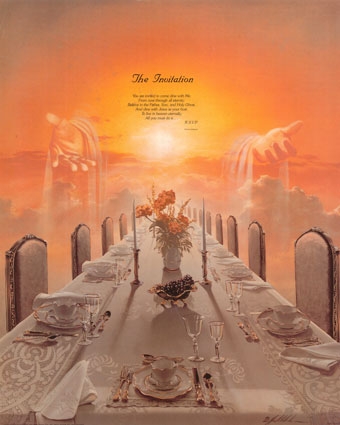
God has invited us to a wedding feast, and an eternity with him. Our invitation comes with a garment that we must receive and put on to enter: Christ’s righteousness. We do this by trusting in His life and finished work on the cross to cover our sins, without any bit of trust in our own merit or good works. If we trust in ourselves, our own righteousness, and our good works to gain us entrance to the feast, we wil be cast in to utter darkness: eternity in hell. However, the kingdom of heaven is opened to those who will set aside their own righteousness and by faith accept Christ’s righteousness.

My friends, there is a heavenly wedding feast awaiting, and your invited. The question is, do you have the attire?


“You are altogether beautiful, my darling.” -God

You are altogether beautiful, my darling, And there is no blemish in you.” Song of Solomon 4:7

“The greatest task of the believer is to seek out and try to discover how much God loves them.” -Paul Washer

The hardest thing to believe is the way that our God loves us. He loves us with a pure and perfect love, and when he looks on us, he says, “You are altogether beautiful, my darling.” It is so hard to believe it, because our culture gives us such a shallow definition of love. But oh, this love, we have never seen anything like it! Think about it, the God who created ENTIRE UNIVERSE looks on US, and says, “You are beautiful, my darling.”

Why does he view us as beautiful? Because Christ is beautiful! We are told that any good thing we do as an unbeliever is nothing but “filthy rags” (Isaiah 64:6). Picture yourself, before you come to Christ, standing, wearing nothing but filthy, dirty rags. You see, Jesus also wears a garment, it is a cloak of perfect righteousness, and it is utterly beautiful. When we lay everything at the cross and come to Jesus to save us from our sin, he strips us of our filthy rags, and he places HIS cloak of righteousness over us, and WE are made righteous. When God looks upon us, he doesn’t see the old, wicked, rebellious sinner. He sees his Son’s cloak of righteousness, his Son’s beauty, and he regards US as beautiful.

We ought not to only say, “Christ died for us.” You see, Christ also lived for us! He stepped down from his heavenly throne and lived a perfect life, full of good works, filled with love, mercy, and grace! He lived this life so that by going to the cross and being crushed for our sin (Isaiah 53:5) God the Father’s wrath would be taken out on him, and that we, by believing in him, may be given his perfect obedience as our own. This is what the second part of the Song of Solomon verse is referring to when it says, “and there is no blemish in you.” ! How amazing is this! That when the God of the universe looks on us, he loves us and sees us as beautiful, because we have Christ’s perfect obedience and life laid over our own lives. He sees us as PERFECT! He sees no blemish in us! This is how he can love us so much and be so passionate about a relationship with us!

God pursues his children. Constantly. He loves them so much! He is always calling them, “Come, come, come” and he makes sure that they will. This is why someone who says they were saved twenty something years ago by saying a prayer but have never grown, they have not come to love God’s people, and they have never encountered God, probably are misunderstanding salvation..and have not truly been saved…because God PURSUES his children! Oh, that you would not experience a life without the Father’s love! He desperately wants you to come to him and seek him and love him! When we focus our eyes on heaven, when look to Jesus, when we pray with a pure heart, his heart beats faster and faster. That’s how much he loves us, he PASSIONATELY desires you! Our God is such a lover. Our love for him, regardless of how small it may be, is cherished by him! Paul Washer says that,”Every time that we cut our eyes to heaven, it is as if the heart of deity beats faster!” Oh, how God loves his children coming to them in prayer!

True religion is not trying to do better or doing the right thing, the real religion is, “He saved me, I want to know Him, I want to please Him, I want to love Him!” He loves us this much! This will drive the unconverted, falsely assured “Christian” to think that this gives him the license to sin, because he will simply be forgiven. Oh, how wrong he is! This truth of how much our God loves us will drive the converted, genuine Christian to say, “If he loves me this much, I want to be for him all that he wants me to be!,” which will ultimately cultivate obedience.

If you are in Christ, God really does love you this much. He sees his only begotten Son, whom he so desperately loved, every time that he looks at you. His righteousness is yours. I plead with you to come to him! This love relationship is unlike any other you will ever experience on this earth. It is so hard for us to fathom because we have never seen anything like it. Come to Him, pray to Him, seek Him, love Him, cut your eyes to heaven and make His heart beat faster! He is longing to hear from YOU!

Gospel Call: “Come to me….and I will give you rest.” -Jesus

We read Jesus’ words in Matthew 11:28, “Come to me, all who labor and are heavy laden, and I will give you rest.”  This is one of my favorite verses of scripture because it depicts the call to salvation, a demonstration of what saving faith looks like, and the promise of rest that Jesus intends for us to live with! So, let’s unpack it:

First, Jesus issues a command: “Come.” It’s a simple term, but can mean so much. How do we come to him? Well, we can’t come to him with the idea that he will just be the cherry on top of our lives. That’s not coming to him. We don’t just need Jesus as another component to our lives to just complete our lives, we have to come to him with the intent of making him the center of our life, laying everything down at the feet of the cross. “I am the bread of life,” Jesus declared; “he who comes to Me shall not hunger, and he who believes in Me shall never thirst” (John 6:35).

Jesus issues the command to “Come” to those who labor and are heavy laden. The Pharisee’s at the time were imposing so many religious laws, acts, and rituals on the Jew’s at the time, that if they made even a small error they were counted unrighteous and unfit for heaven. Jesus is saying, “Are you tired of working for salvation? Are you tired of worrying if you’ve done enough to get into heaven? Are you tired of trying hard to be good enough to please my Father? Good, you should be, because you can’t please him…on your own. ” If anyone at the time felt like this, they were personally encouraged by Jesus to come to him. Although the term itself is not used in the text, Jesus gives a call to repent, to turn away from the self-centered and works-centered life and come to Him. The person who is weary and heavy-laden despairs of his own ability to please God. He comes to the end of his own resources and turns to Christ. Desperation is a part of true salvation, because a person does not come to Christ as long as he has confidence in himself. To repent is to make a 180-degree turn from the burden of the old life to the restfulness of the new. If a person does this, Jesus promises them rest.

So, what is the rest that Jesus promises?

The dictionary gives several definitions of rest that remarkably parallel the spiritual rest God offers those who trust in His Son. First, the dictionary describes rest as cessation from action, motion, labor, or exertion. In a similar way, to enter God’s rest is to cease from all efforts at self-help in trying to earn salvation. Second, the dictionary defines rest as something that is fixed and settled. Similarly, to be in God’s rest is to have the wonderful assurance that our eternal destiny is secure in Jesus Christ, our Lord and Savior. If we back up to verse 11, Jesus says that there is no one on earth who is greater than John the Baptist, yet the person who is least in the kingdom of heaven is greater than he! Guys, we have such an amazing glory awaiting us in heaven. Jesus promises us that even the person who is the least in heaven, is considered much greater than the best person who lived on earth! And if we come to Jesus, he promises that this glory awaits us! At the end of our lives, if we are in the faith, we are not rewarded for what we have done, we are rewarded for what Christ has done! And how much glory and praise does He deserve!?- So much that there cannot even be a time frame on it, because it would not be enough-it has to be eternal!

Third, rest is defined as being confident and trustful. When we enter God’s rest we are given the assurance that “He who began a good work in [us] will perfect it until the day of Christ Jesus” (Philippians 1:6). Finally, the dictionary describes rest as leaning, reposing, or depending on. As children of God, we can depend with utter certainty that our heavenly Father will “supply all [our] needs according to His riches in glory in Christ Jesus” (Philippians 4:19).

My friends, you are invited to this eternal rest. Hebrews 7:25 says, “Therefore he is able to save completely those who come to God through him, because he always lives to intercede for them.”

He promises rest, and so much more. It’s up to you to go to him!