Does God Desire To Show Some of His Attributes More Than Others? -Dr. David Holt

God “much prefers” to express His compassion and grace than His judgment and discipline.  I can relate to this as a father.  I “much prefer” to be gracious and giving to my children rather than discipline them for disobedience.  I will do the latter if their behavior warrants it, but I “much prefer” the former.

And so it is with God and us. He “much prefers” that we remain in intimacy and obedience with Him, so that He can bless, help, show compassion, empower and reward us. But if our behavior warrants His judgment and discipline, He will have to express that. Continue reading “Does God Desire To Show Some of His Attributes More Than Others? -Dr. David Holt”

Coming to the Blood of Jesus -Spurgeon

and to Jesus, the mediator of a new covenant, and to the sprinkled blood that speaks a better word than the blood of Abel.”    – Hebrews 12:24

Reader, have you come to the blood of sprinkling? The question is not whether you have come to a knowledge of doctrine, or an observance of ceremonies, or to a certain form of experience, but have you come to the blood of Jesus?
The blood of Jesus is the life of all vital godliness. If you have truly come to Jesus, we know how you came–the Holy Spirit sweetly brought you there. You came to the blood of sprinkling with no merits of your own. Guilty, lost, and helpless, you came to take that blood, and that blood alone, as your everlasting hope. You came to the cross of Christ, with a trembling and an aching heart; and oh! what a precious sound it was to you to hear the voice of the blood of Jesus! Continue reading “Coming to the Blood of Jesus -Spurgeon”

An Example of Praying Without Ceasing- Sir Thomas Browne

thomasbrowne

Despite a time where England was passing through a period of national convulsion and political excitement, men and women of God found comfort and strength through prayer. One beloved English physician, named Sir Thomas Browne, is one of these men. He wrote in his journal,”I have resolved to pray more and pray always, to pray in all places where quietness invites, in the house, on the highway and on the street; and to know no street or passage in this city that may not witness that I have not forgotten God.”

Do we witness that we have not forgotten God in all places?

Browne adds, “I purpose to take occasion of praying upon the sight of any church which I may pass, that God may be worshiped there in spirit, and that souls may be saved there; to pray daily for my sick patients and for the patients of other physicians; at my entrance into any home to say, “May the peace of God abide here;” after hearing a sermon, to pray for a blessing on God’s truth, and upon the messenger; upon the sight of a beautiful person to bless God for His creatures, to pray for the beauty of such an one’s soul, that God may enrich her with inward graces, and that the outward and inward may correspond; upon the sight of a deformed person, to pray God to give them wholeness of soul, and by and but to give them the beauty of the resurrection.”

May adding constant daily patterns of prayer give us comfort and strength through our hard times?

Discovering The True Jesus (pt.3)- The Birth of a Savior

For unto you is born this day in the city of David a Savior, who is Christ the Lord. And this will be a sign for you: you will find a baby wrapped in swaddling cloths and lying in a manger.”   Luke 2:11-12

The virgin birth. In America, most of us hear this story every year during the Christmas season, so much so that I believe we have become calloused to the extraordinary way that Jesus entered into our world. The Bible teaches that Jesus was conceived by the Holy Spirit in a virgin named Mary. The angel Gabriel tells Mary, “behold, you will conceive in your womb and bear a son, and you shall call his name Jesus.”

Often times, we think of Jesus starting His whole life as an infant, but the Bible also teaches that He existed with the Father for all of eternity past. In the book of John, the author describes Jesus as the “Word,” stating that He was with God the Father in the beginning, and that God created all things through Him (John 1:1-3). God says before He creates man, “Let us make man in our image” (Gen 1:26). So, lets think briefly about the transition from Jesus’ life in heaven to His “birth” on earth….what do you think it was like?

Hard to think about, isn’t it? Thankfully, in Philippians, the author lays out for us what Jesus did when He chose to come to earth:”Christ Jesus, who, though he was in the form of God, did not count equality with God a thing to be grasped, but emptied himself, by taking the form of a servant, being born in the likeness of men” (Phil 2:5-7). Jesus completely humbled himself in leaving his heavenly throne to come live as one of us….to ultimately die for us and save us. He was born in the likeness of men, so that He could be the perfect sacrifice for men.

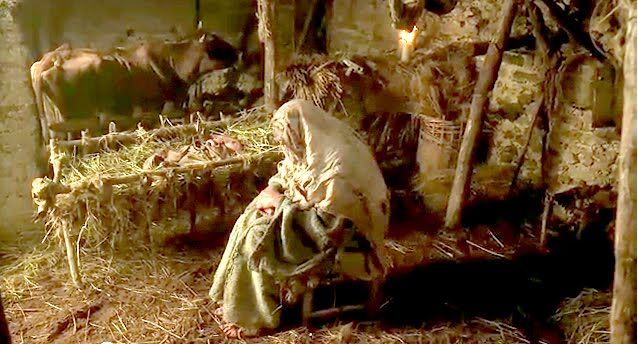
Speaking of Jesus’ humbling himself, look at where He was born! In our first text in Luke, we saw that it was said that Jesus would be found lying in a manger. A manger is a feeding trough used to feed farm animals. It was in the center of the holding houses and likely the dirtiest part of the barn. When animals eat…they often relieve themselves in the same spot. This is likely what the scene actually looked like:

manger

Jesus, the Son of God, came into the earth and spent His first few minutes on earth in one of the dirtiest environments. Why? Humility. Jesus humbled Himself, remember? Is this the way for an earthly King to enter the world? Certainly not. But we will learn of Jesus throughout our study, that He does nothing like an earthly king would do. “My kingdom is not of this world” Jesus says in John 18:36. But I also believe that this was God’s way of showing that Jesus was the real deal. Jesus was humble and a servant from the get-go. He was willing to do whatever it takes to complete His purpose, and in this case-that meant being born in a dirty manger.

The last piece of this story that I want to unfold is: why was it necessary for Jesus to be born of a virgin?

All throughout the Bible, God required a perfect sacrifice to be made before Him to pay for sin committed. In the Old Testament, God’s law required His people to sacrifice “unblemished” lambs, bulls, and goats. If the sacrifice wasn’t perfect before God, it was unacceptable. In the same way, for Jesus to be the perfect and final sacrifice, He must be perfect and unblemished before God. Ever since Adam sinned in the garden, every human being has been born into sin, and the Bible depicts sin nature passing down from generation to generation through the father (Romans 5:12,17,19). It was critical Jesus not to be “born in sin” so that He could fulfill His role as the perfect sacrifice. This is why the Holy Spirit conceived Jesus in Mary’s womb, so that Jesus could circumvented the transmission of the sin nature and become a perfect man.

This little story has more depth than you thought, didn’t it? Its read every year at Christmas, but certainly worth celebrating the entire year. It marks the beginning of Jesus’ life on earth, and is absolutely crucial to the fulfillment of the rest of His mission. Jesus wasn’t only born in a dirty manger, but He would die on a bloody cross.

Tune in next week for part 4 of this series.
Discovering The True Jesus (pt.1)

For one of my Marketing classes this fall, I am required to write ten different blogs about anything that I am passionate about to practice gaining a presence on the web and to better “market” myself to employers/network associates/etc. So…I had to choose what to write on that would have a consistent theme throughout the semester. After much thought, I decided to write about….Jesus. Instead of marketing myself, why not market Him? Most of what I do in my life is based off of who He is and what He did- so why not share that with my peers and fellow students?

In order to do this, I plan on analyzing ten major events, stories from, or teachings about Jesus from the Bible, so that I can paint an overall picture of who the true Jesus is, and what He came to accomplish on earth. I hope that you will join me regularly on this journey, and comment and interact with me as I seek to unveil the truth about the most influential human being that ever walked the earth!

So, for my first post, I will simply introduce Jesus from a historical perspective, and how He is viewed by the world. Most credible historians agree that a man named Jesus did live 2000 years ago, and quickly gained a following that changed the course of the future forever. Josephus and Tacitus are some of the main secular historians who wrote about Jesus as they recorded events in Jerusalem and Rome near Jesus’ lifetime. However, there are countless hundreds of individuals who wrote about Jesus’ life, relaying information that they heard from eyewitnesses, within 100-200 years after His death. Any argument that Jesus never existed is not very credible, and goes against the grain of many leading (even secular) scholars. So then, if Jesus existed, what do people believe that He actually did? Who was He?

People of Jewish descent believe that Jesus was a man who claimed to be a messiah (a savior for the nation of Israel) but that He was a false messiah. Muslims believe that Jesus was just another prophet in a line of prophets before Muhammad. Secular historians believe that Jesus was just another religious individual who gained popularity after His death and started a new world religion. Christians believe that He is the Savior of the world, the Son of God who ransoms mankind. But most would refer to Jesus simply as a “good teacher” or a man with many helpful and wise teachings.

However, if Jesus is only a “good teacher,” what must we do with the fact that He claimed to be God’s Son? That He said He was the Messiah? That He said He would raise from the dead? Would “good teachers” say these things about themselves? I think not! Jesus, then, must either be a liar, a lunatic, or who He said He was. He cannot be just a good teacher, or even a prophet (because good teachers or prophets would not make false, incorrect claims about their identities and still be considered “good”). He is either intentionally lying (trying to deceive others), or He is crazy (He thinks He’s God’s Son!) or He is who He said He was (He was telling the truth!). These are the only three options for who Jesus can actually be.

So….who is He? What evidence is their to back up some of the world’s major views of Him? Is He who He claimed to be? Or was He disiluusioned? To learn about anyone’s life, we must go to the people that knew them best: their family members, their friends, their colleagues. Thankfully, Jesus’ closest friends wrote about His life in four distinct books called the Gospels. We will take a look at one story in the next blog and try to come a little farther in answering the question, “Who is the REAL Jesus?”

Seeing the Goodness of Our God

Topaz-Waters-beautiful-nature-21888528-1217-812

The more closely we study ourselves, the more beneficent our Creator becomes. Look at the highest of God’s earthly creatures-man. We have plenty of reasons to say with the Psalmist, “I will praise you, for I am fearfully and wonderfully made: marvelous are your works; and that I know full well” (Psalm 139:14). Everything about the structure of our bodies attest to the goodness of our Maker. How suited are our hands to perform work! How good of the Lord to appoint sleep to refresh our wearied bodies! How benevolent His provision to give to the eyes lids and brows for their protection! We could continue indefinitely!*

The goodness of God is also seen in the variety of natural pleasures that He has provided for his creatures. God could have decided to satisfy our hunger without allowing us to really enjoy the taste of it- yet how good is He that he gave us such flavors as those in meat, vegetables, and fruits! He has not only given us senses, but also things that will gratify our senses, and this too reveals His goodness. The earth could have been fertile as it is without its surface being so delightfully multicolored. Our physical lives could have been sustained without beautiful flowers to please our eyes with their colors, and our nostrils with their sweet perfumes. We might have walked outside without hearing the music of birds. Why then, is all of this loveliness so freely diffused over the face of nature? Because the tender mercies of the Lord “are over all His works” (Psalm 145:9).*

When others behave badly to us, it should only stir us up the more heartily to give thanks unto the Lord, because He is good; and when we ourselves are conscious that we are far from being good, we should only the more reverently bless Him that He is good. We must never tolerate an instant’s unbelief as to the goodness of the Lord; whatever else may be questioned, this is absolutely certain, that Jehovah is good; His dispensations may vary, but His nature is always the same (C.H. Spurgeon).

Gratitude and thankfulness is the return justly required from us, the objects of His goodness. Yet we often do not give it to God because His goodness is so constant and so abundant. It is lightly esteemed because it is exercised toward us in the common course of events. It is not felt because we daily experience it!* We must labor to not allow this to be so!

Praise the Lord for His Goodness!!

*My translation from A.W. Pink’s “Old” English language (Attributes of God, Ch. 11, The Goodness of God)

Looking Unto Jesus- Charles Spurgeon

“Looking unto Jesus.” —Hebrews 12:2

“It is ever the Holy Spirit’s work to turn our eyes away from self to Jesus; but Satan’s work is just the opposite of this, for he is constantly trying to make us regard ourselves instead of Christ.

He insinuates, ‘Your sins are too great for pardon; you have no faith; you do not repent enough; you will never be able to continue to the end; you have not the joy of His children; you have such a wavering hold of Jesus.’

All these are thoughts about self, and we shall never find comfort or assurance by looking within. But the Holy Spirit turns our eyes entirely away from self: He tells us that we are nothing, but that ‘Christ is all in all.’

Remember, therefore, it is not thy hold of Christ that saves thee—it is Christ; it is not thy joy in Christ that saves thee—it is Christ; it is not even faith in Christ, though that be the instrument—it is Christ’s blood and merits.

Therefore, look not so much to thy hand with which thou art grasping Christ, as to Christ; look not to thy hope, but to Jesus, the source of thy hope; look not to thy faith, but to Jesus, the author and finisher of thy faith.

We shall never find happiness by looking at our prayers, our doings, or our feelings; it is what Jesus is, not what we are, that gives rest to the soul. If we would at once overcome Satan and have peace with God, it must be by ‘looking unto Jesus.’

Keep thine eye simply on Him; let His death, His sufferings, His merits, His glories, His intercession, be fresh upon thy mind; when thou wakest in the morning look to Him; when thou liest down at night look to Him.

Oh! let not thy hopes or fears come between thee and Jesus; follow hard after Him, and He will never fail thee.

‘My hope is built on nothing less
Than Jesu’s blood and righteousness:
I dare not trust the sweetest frame,
But wholly lean on Jesu’s name.’”

spurgeon_bw

–Charles Spurgeon, “June 28 – Morning” in Morning and Evening (Geanies House, Fearn, Scotland, UK: Christian Focus, 1994), 378.

Missions Exists Because Worship Doesn’t

“Missions Exists Because Worship Doesn’t” -John Piper

missions

This semester, the Lord led my fiancée and I into a class called Perspectives that our church was hosting. The class is basically a college-type class set up to give believers a fresh “perspective” on the world christian movement, and to give a glimpse of what God is doing around the world. The first week we learned how God has been a missionary God from the very beginning, in his promise to Abraham to make him a blessing “to the nations.” But this week, we talked about the main point of missions-to bring worship to God and to bring him the glory and honor he deserves. One of the main quotes from the lesson was, “Missions exists because worship doesn’t” originally coined by John Piper. I just want to share a quick quote from our reading, and a conviction that I was confronted with.

This is the quote from this week’s reading, “The Story of His Glory,”:

“Humanity does not deserve the love of God any more than you or I do. We should never be Christian humanists, taking Jesus to poor sinful people, reducing Jesus to some kind of product that will better their lot. People deserve to be damned, but Jesus, the suffering lamb of God, deserves the reward of his suffering.”

I was convicted because of this: most of my evangelism and missions-mindset was just to save people from hell, and to show them the full life Jesus wants for them. However, Its not all about what we are saving them FROM but what we are saving them FOR- the worship of a worthy Savior.
We don’t just labor to save people from an eternity in hell, we labor to win our Savior the crowns he deserves for his life and sacrifice, and to bring Him the glory and worship that he deserves for all of eternity!

Thus, our neglect of evangelism and participation in missions is not only unloving to the lost, but it is a refusal to bring God the glory, worship, and honor that he deserves. And our participation in missions and evangelism is not only loving to the lost, but is obedient to God’s plan for our lives: to bring Him worship from every tribe, tongue, and nation!

We take part in missions because there are still tribes and people groups, friends and coworkers, family members and strangers, who do not worship our Father. We labor in part because of our yearning for them to avoid eternal punishment, but our main incentive should be drawn from our own love and adoration of the Father! We know how worthy he is of praise and worship, and we must devote ourselves to winning it for him from the people that do not know him.

The Father sent his only son, Jesus, who, through his death and resurrection, bridged the gap between our sinfulness and God’s holiness, so that we would be reconciled to God (1 Peter 3:18) and worship him! He extends grace and love to us, that we would return love and worship to him. This is the desire of his heart is to receive worship from his creation. This is what was broken in the garden of Eden, the ability to worship the Lord in truth and have a relationship with him. But now, through Christ, we are more than able! Not only that, we are entrusted as his children to win him the worship and glory that his mighty name deserves!

The question we must ask ourselves is this: What is my part in winning the blessed Savior this worship that he is so deserving of?

May the Spirit guide you as you commit yourself to his eternal purpose!

God’s Sovereignty In the Book of Acts: Ordaining the Cross

God’s-Sovereignty

“His Sovereignty rules over all.” – Ps. 103:19

I have often heard the phrase, “God is sovereign” in a way that has been spoken to me to give me encouragement in a tough time or situation. But I never really took the time to meditate on what it meant for Him to be sovereign. The term is defined by having supreme power and authority, a free ability to do as one pleases. In other words, God is in absolute control over every situation, and works out everything according to His will. Think on it for a while, and it will drive your brain into massive confusion. However, we are called to submit ourselves to and believe what scripture tells us, and trust in his sovereignty.

These past few days, I have read through the book of Acts, and I was struck with how much it reveals about God’s sovereignty-with regards to salvation! I simply would like to share them with you in a 3 part series, so that you too can see how God has worked out salvation for his people, and how you, too, if in Christ, were brought into salvation by his amazing grace.

In this first post, Lets look at the major theme of sovereignty in how God ordained the cross:

  • Jesus, delivered up according to the definite plan and foreknowledge of God” Acts 2:23

I had a very interesting conversation with a Muslim man the other day, who asked me if Christians hated Jews, because they were the ones who “killed Jesus.” This was the first time that I had really come across this misconception. Before I could reply, my friend with me answered, “No,no,no, we don’t hate them at all. We believe it was God’s plan all along, that he used the Jews and the Romans to accomplish his purpose of sacrificing Jesus!” This can be a tough pill to swallow, but Acts 2:23 clearly states for us that Jesus was crucified because it was the definite plan and foreknowledge of God. Let’s look at another verse:

  • What God foretold by the mouth of all the prophets, that his Christ would suffer, he thus fulfilled.” Acts 3:18

In this verse we are told that not only did God plan it from the beginning, but you can see his plan through reading the prophets in the Old Testament. Lets look at one of the most well-known passages. Isaiah 53:5 reads, “But he was wounded for our transgressions, he was bruised for our iniquities: the chastisement of our peace was upon him, and with his stripes we are healed.” Isn’t is incredible that these words were written 600-700 years before Jesus birth? There are over 300 in the Old Testament like it! God surely had a plan, and was voicing it to his people all throughout history.

If you haven’t been convinced yet, lets look at one last verse,

  • For truly in this city there were gathered together against your holy servant Jesus…Herod and Pontius Pilate, along with the Gentiles and the people of Israel, to do whatever your hand and your hand had predestined to take place.” Acts 4:27-28

In the most heinous crime committed in the history of mankind, God was behind the scenes, sovereignly ruling. His hand predestined for Jesus to go to the cross, and to bear the weight of our filthy sin. He planned it all, so that whosoever would repent and believe in Him, would have eternal life. This was the depth of his love for us, that he would send his own Son, who would be despised and rejected, so that we might have life with Him. “But God showed his love for us in that while we were still sinners, Christ died for us” Romans 5:8. Recognizing this plan helps us understand the cornerstone of the gospel, seen in Isaiah 53:10,” Yet it was the Lord’s will to crush Him.” Him- meaning Jesus.

People everywhere are commanded to repent and believe in this incredible gospel (Acts 17:30). How could we not accept so great a Savior? How could we not devote our lives to a God, who in his sovereignty planted the very tree that he would be crucified on-all to give us life and relationship with Him?

Truly, He is sovereign.